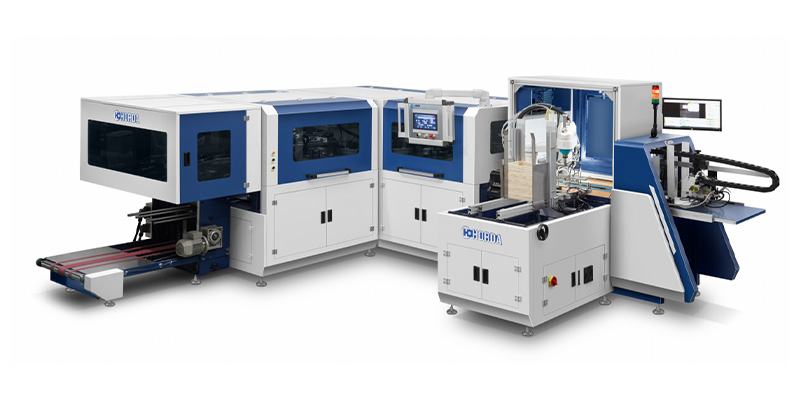
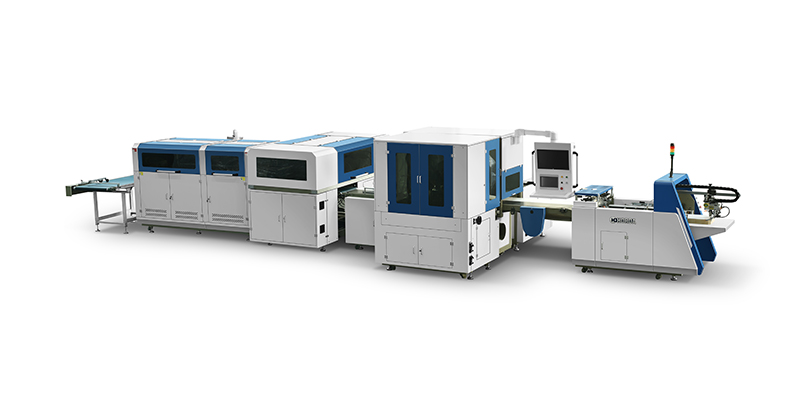
It's 3:00 AM. The night shift supervisor calls. The case making line is spitting out covers with wrinkled spine joints. Again. The glue is pooling on the filpening groove, and a batch of 5,000 hardbound notebooks is about to be scrapped.
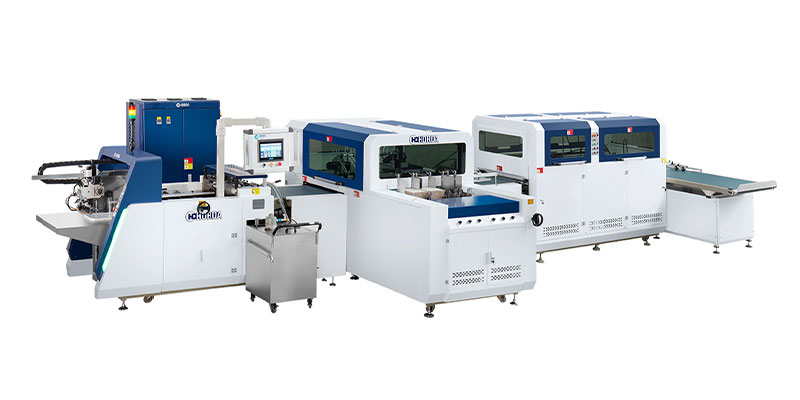
This is the silent nightmare of rigid packaging production. Whether you are running presentation folders for a law firm or photo book covers for a print-on-demand service, the physics are brutal: board thickness varies, glue viscosity drifts, and humidity warps paper.
Most operators blame the material. But according to a 2024 binding industry audit, over 60% of cover defects trace back to mechanical misalignment in the feeding and positioning stage—not the board itself.
So why do some factories run perfect batches for hours while others fight constant rejects?
Let's cut through the marketing fluff. Older machinery relies on mechanical stops and manual cranks. You set the width. You lock the screw. You pray the next box is the same size.
Blind Spot #1: The Floating Board
Cardboard is never perfectly square. Recycled board warps; high-end board has grain direction issues. Traditional cam-driven systems push the board forward blindly. If the board shifts 0.5mm, the cover shifts 2mm by the time it reaches the grooving station.
Blind Spot #2: Glue Application Variability
Cold glue thickness changes with temperature. Hot melt viscosity changes with ambient humidity. A rigid glue nozzle that doesn't adjust in real-time will either starve the joint (weak bond) or flood it (drying time nightmare).
Blind Spot #3: The "Human Delay" in Changeovers
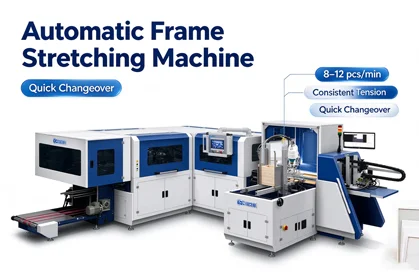
Ever watched an operator spend 45 minutes re-calibrating side registration guides? That is lost production. Worse, rushed changeovers lead to cracked hinge scores on the next 200 units.
Here is where the industry shifted about five years ago, but many buyers still don't know what to look for.
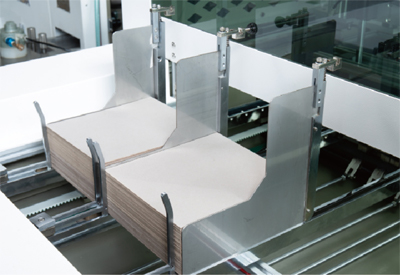
Instead of mechanical bump-stops, modern case making equipment uses photoelectric sensors to "see" the board before it enters the glue station. Think of it like autofocus on a camera—continuous, silent, real-time.
Three sensors are the magic number. Why? Because one sensor detects leading edge. Two more detect lateral drift (left/right). When all three talk to a servo-driven positioning table, the machine corrects the board's path 50-60 times per second.
This is not a luxury. For case makers running variable thickness stock (e.g., 1.5mm to 4mm board), it is the difference between a 98% yield and an 88% yield.
Most entry-level machines use a mechanical clutch and brake. Loud. Inconsistent. Requires monthly pad replacement.
Servo motors are different. They are electrically synchronized. They don't "stop" a moving part—they decelerate it with precision to 0.01mm accuracy.
According to energy efficiency data from industrial motor suppliers, servo-driven cover lines consume 30% less electricity than pneumatic or clutch-brake equivalents, simply because they aren't constantly fighting inertia.
Real-world impact? One medium-sized hardcover photo book manufacturer I spoke with cut their reject rate from 4.2% to 0.7% after switching to a three-sensor servo system. That is 3,500 fewer scrapped books per 100,000 units. At 2perbook,that′s2perbook,that′s7,000 saved per run.
Here is a controversial opinion: multi-purpose folder-gluer machines that claim to handle "everything from envelopes to rigid boxes" usually handle nothing well.
File folder production has unique demands: pocket gluing, score alignment for the flap, and tab cutting registration. A generic case maker may technically fold a folder, but will it maintain ±0.3mm on the thumb cutout position? Probably not.
If your primary product is pressboard folders or document wallets, you need a line designed for thin, springy materials—not thick book board. Look for lightweight board handling kits and anti-static feed wheels.
Ask any veteran operator: "What fails first on a cover production line?"
The answer is almost always the delivery belt or the glue pot seals.
A professional-grade system should offer tool-less belt changes (under 10 minutes) and stainless steel glue reservoirs (resists corrosion from acidic adhesives). If a salesperson cannot show you a quick-access maintenance hatch, walk away.
Here is the honest truth: You cannot have "Formula 1 speed" and "surgical precision" on the same exact machine unless you pay for dual-drive servos and rigid chassis construction.
For mass-market paperback covers? A cam-driven line with simple registration is fine (lower cost, higher speed).
For luxury rigid boxes, foil-stamped hardcovers, or medical file folders? You need the three-photoelectric-sensor, servo-positioning architecture.
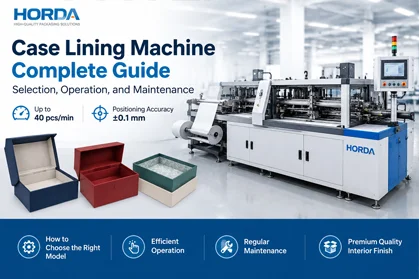
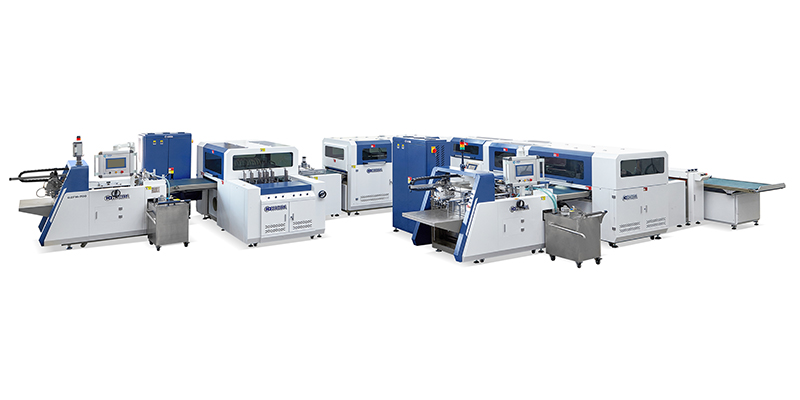
The Horda platform in this category uses that exact triple-sensor layout combined with independent servo drives for the feeder, gluer, and nipping station. This means each module adjusts without stopping the whole line.
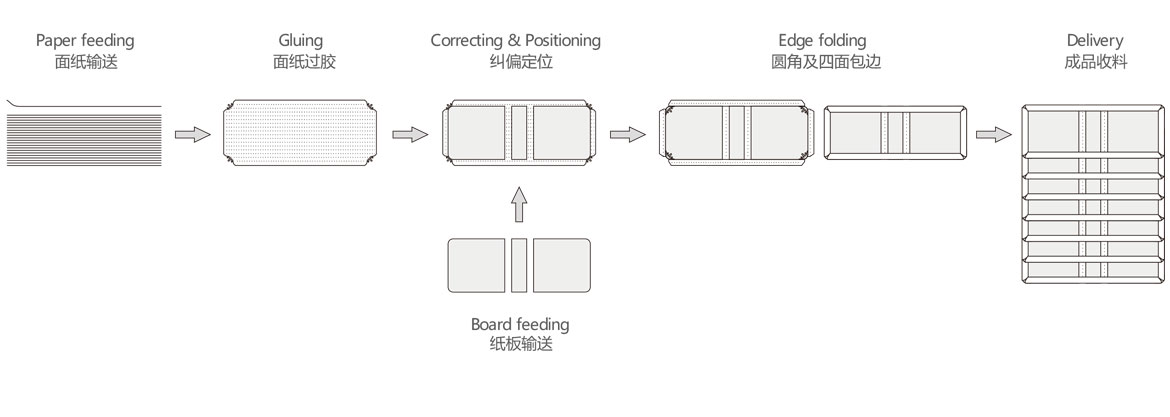
If you want to see how a rigid book cover line handles variable board thickness without operator intervention, click here to explore.
Before signing any PO, run this three-step field test:
Ask for a "warped board" demo. Bring your worst material. Watch if the machine jams or corrects.
Time a changeover. From last good box of size A to first good box of size B. Under 15 minutes? Acceptable. Under 5 minutes? Excellent.
Check the glue station. Can you clean it without removing six bolts? If not, your operators will hate the machine.
The bottom line: Perfect hardcover book covers and precise file folders are not accidents. They are the result of photoelectric eyes watching every millimeter and servo muscles reacting faster than any human ever could. Invest in the feedback loop, not just the frame.

 English
 Español
 Português