When a production manager stands on the factory floor watching a mountain of diverse, unfinished boxes pile up, the question isn’t just about "automation." It is about survival against the clock. The immediate answer buyers search for is this: Do not look for maximum speed first. Look for changeover tolerance.
Most buyers make the expensive mistake of prioritizing "cycles per minute" (PPM). Yet, according to industrial automation benchmarks, up to 35% of downtime in automated lines comes not from motor failure, but from lengthy SKU changeovers . If your line takes 30 minutes to adjust from a small pharmaceutical box to a bulky electronics box, you aren't automated—you are just a fast manual labor replacement.
Before you write a check, ask the supplier one brutal question: "How many different box sizes can you run in an hour without stopping the conveyor?"
In the world of case erecting and sealing, rigidity is the silent killer of ROI. Many standard solutions operate like a one-trick pony. They glue or tape boxes perfectly—as long as the box is exactly 300mm x 200mm. The moment your order mix shifts to a 400x150mm profile, the line stutters.
I’ve seen warehouses where the automatic carton sealing equipment sits idle for 40% of the day because the team is waiting for an engineer to recalibrate the box infeed mechanism. This is where the industry is splitting into two camps: the "Speed Monsters" and the "Flexible Solvers."
If you are packaging the exact same product for the next five years (think a massive dairy order or a single SKU e-commerce item), your priority is raw throughput. You want a continuous motion system. You don't care about complexity; you care about linear velocity. These systems often utilize hot melt adhesive systems running at full tilt.
But here is the catch: If your business model ever shifts to "mass customization"—which most are doing to stay competitive—these rigid systems become a financial anchor.
This is where the conversation gets interesting. For the majority of mid-sized manufacturers—handling lidded rigid boxes, gift sets, or complex retail packaging—the priority is changeover speed.
Instead of looking for just an "automatic cover line," look for a servo-driven modular platform.
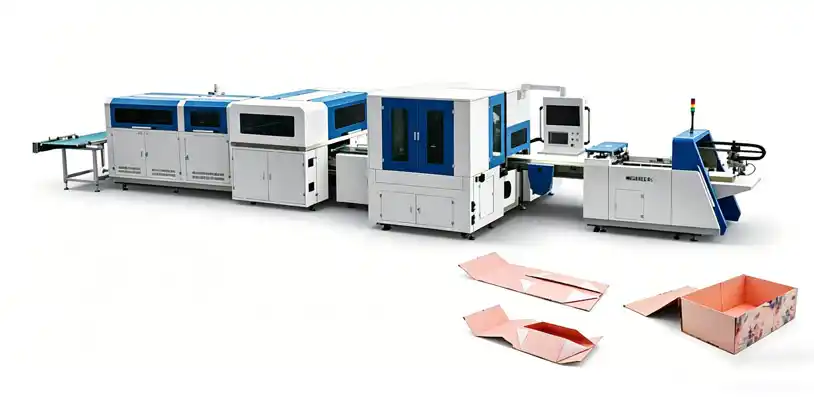
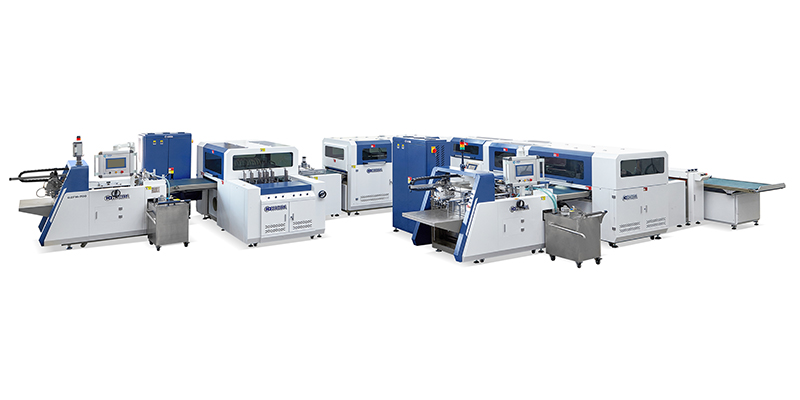
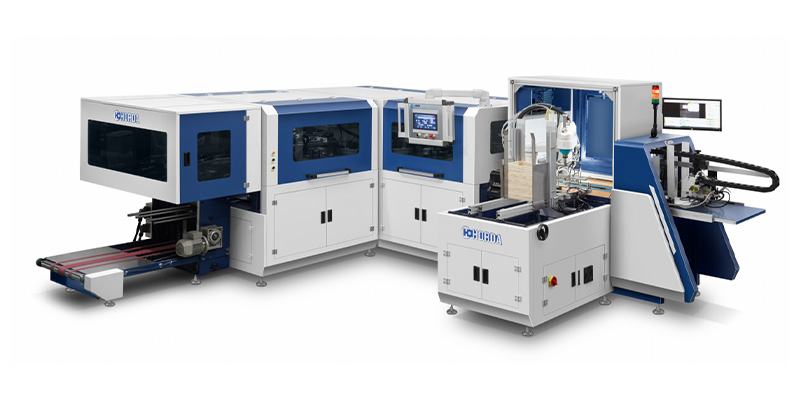
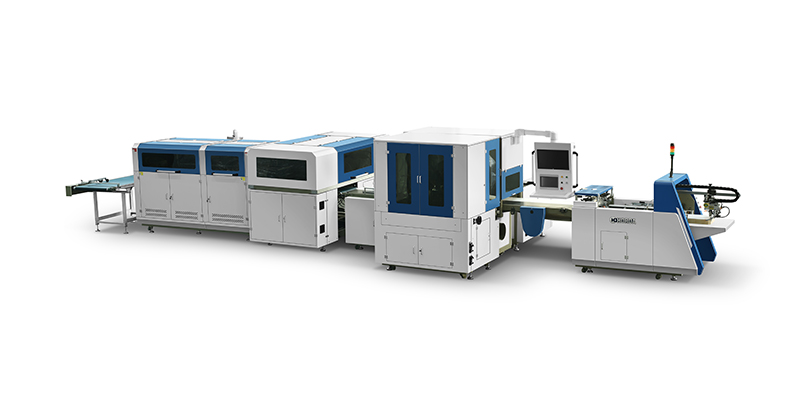
This is precisely where the Horda ZFM Series differentiates itself. While generic systems rely on manual crank adjustments that take 20+ minutes, specific configurations like the fully automatic case making machine utilize servo drive motors and hydraulic adjustments to resize the line in under 60 seconds . When evaluating how to Select an Automatic Cover Line for Boxes, look at the gluing precision. Does the system have a photo-sensor feedback loop? If not, your "automatic" line will waste high amounts of glue on misaligned covers .
You see the stickers on the side of the machine. But in a real-world factory, dust, vibration, and temperature swings kill electronics. A robust solution must have IP protection for sensors.
Horda’s recent showcases at events like China Print 2025 highlighted a shift from "hardware selling" to "smart factory supply chain" integration . The modern buyer needs a line that speaks MES (Manufacturing Execution System) language. Can it report a jam to your ERP instantly? Can it predict maintenance?
If you are comparing solutions, force the vendors to show you the data output protocol. A truly automatic line is a data node, not just a motor.
A specific nuance in cover line selection is the adhesive type.
Hot Melt: Fast setting, great for high speeds, but messy and requires venting.
Cold Glue: Cheaper, stronger bond, but requires drying time (slows the line).
Tape: Simple, but looks cheap on a premium rigid box.
The best automatic cover lines now offer integrated dual-function applicators that allow you to switch without changing the mechanical head. Look for stainless steel application valves that resist clogging—a massive pain point that maintenance logs never show but operators complain about daily.
So, you have a spreadsheet full of quotes. One says 40 boxes/min. Another says 35. The cheaper one is tempting.
Stop looking at the peak speed. Look at the Mean Time Between Failures (MTBF) for the feeding system. The most frustrating part of any line is the erector—the part that takes a flat cardboard blank and turns it into a box. If the erector jams, the whole line stops.
To truly Select an Automatic Cover Line for Boxes, you must audit the vacuum feeder. Is it rotary or reciprocating? Rotary is faster; reciprocating is more reliable for warped board. Given the rising cost of recycled cardboard (which is often less rigid), a robust reciprocating feeder will save your sanity.
Don't buy "automation for automation's sake." Buy adaptability.
The future of packaging is not one box; it is a thousand boxes of different sizes arriving in random order. You need a line that treats every box like a custom job but runs it at the speed of mass production.
Ready to audit your current line setup?
Explore the specific mechanical configurations that allow for "one-button" size adjustments click here to view the detailed specs of the cover linkage line.
Ultimately, the right choice balances electrical efficiency (servo motors reduce energy use by 15-30% ) with mechanical forgiveness. If you prioritize changeover tolerance over raw top speed, you will own a machine that pays for itself in uptime, not just a trophy for the factory tour.

 English
 Español
 Português