You run a framing studio that produces dozens of stretched canvases each week for local artists and galleries. Each canvas is stretched by hand—a skilled craft that takes years to master and 20–30 minutes per canvas. One of your framers takes a day off, and suddenly you are behind schedule. A large order from a commercial client arrives, and you realize there is no way to meet the deadline with your current methods.
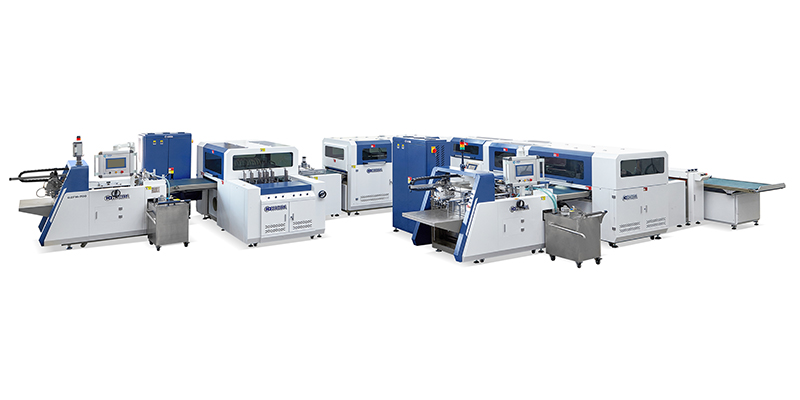
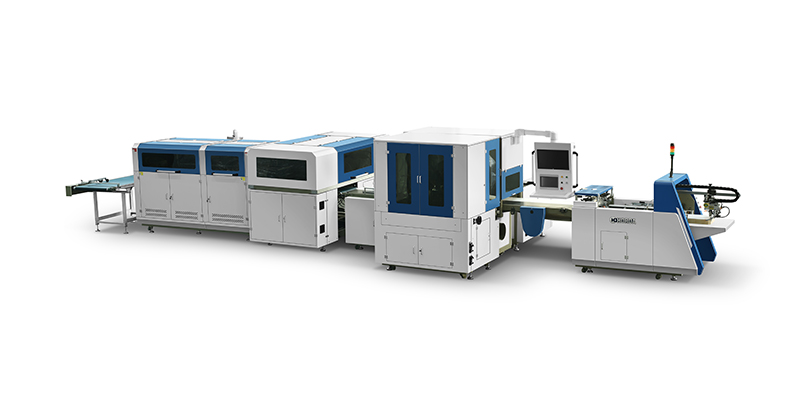
This is the scenario that has driven framing studios, print shops, and canvas manufacturers to explore automatic frame stretching machines. These machines replace manual stretching with mechanized processes that deliver consistent tension, faster production, and reduced labor dependency. But what exactly is an automatic frame stretching machine? How does it work? And what should you understand before considering one for your operation?
This guide explains the working principle of automatic frame stretching machines, breaks down their core components and operational sequence, and helps you understand the key differences between machine types.
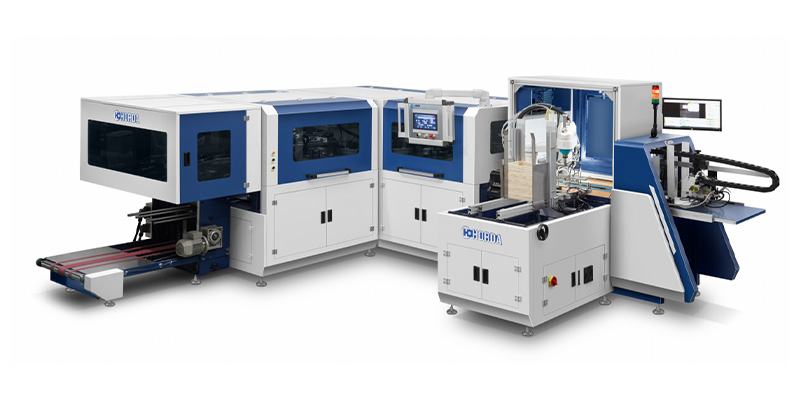
An automatic frame stretching machine is specialized equipment designed to stretch canvas—or similar fabric materials such as linen, cotton duck, or polyester—onto wooden or metal frames, achieving tight, flat, and uniform tension fixing.
The core value of a canvas stretching machine lies in “standardization” and “efficiency.” Rather than relying on an individual framer’s experience and hand strength, these machines use mechanical systems to apply consistent pulling force across all sides of the canvas simultaneously. The machine uses a linkage mechanism to make the pulling force act on the four sides of the canvas synchronously, with tension error controllable within ±5N—a standard that meets professional art framing requirements.
In essence, an automatic frame stretching machine mechanizes the four-step manual stretching process—positioning the canvas, stretching it taut over the frame, folding the corners, and securing it with staples or nails—into a single, repeatable production cycle.
Why This Matters for Your Operation: Consistent tension (±5N error) means every canvas leaving your studio has the same drum-tight quality, regardless of which operator runs the machine. This consistency translates directly to customer satisfaction and reduced rework—critical factors for commercial operations serving digital print shops, art supply retailers, or large-format printing studios.
Automatic frame stretching machines, despite variations in design and automation level, follow a consistent operational sequence. Understanding this sequence helps you evaluate different machines and troubleshoot issues.
Workers place the assembled wooden canvas frame on the machine’s positioning fixture and lock the frame tightly via pneumatic clamping components to avoid displacement during stretching. The positioning system supports adjustable width to fit customized frame sizes. In more advanced machines, this step is partially or fully automated, with some systems featuring automatic frame feeding and positioning to reduce setup time and operator intervention.
Unfinished canvas fabric is spread evenly over the frame surface, with the edge of fabric aligned with the machine’s tension clamping jaws. The automatic leveling structure eliminates fabric wrinkles in advance. Some high-end models are equipped with intelligent control systems that can adjust tension according to the thickness and material of the canvas, further improving equipment adaptability.
This is the core working link of the whole device. Four groups of pneumatic clamps grab canvas edges separately, then pull fabric toward four sides synchronously under set tension parameters. The built-in pressure sensor keeps tension consistent on top, bottom, left, and right sides to prevent local over-stretching or loose fabric.
Why does synchronous pulling matter? If one side is pulled tighter than the opposite side, the canvas will be skewed or develop wrinkles. The linkage mechanism ensures that pulling force acts on all four sides at the same time, maintaining geometric integrity of the stretched canvas.
After reaching the preset tightness, the machine locks the tension state temporarily. Operators can adjust tension intensity according to canvas thickness—soft fabric requires lower tension, while thick linen needs stronger pulling force. The tension can be adjusted from light tension for delicate fabrics to drum-hard tension for heavy cotton duck or primed linen.
With fabric kept flat and tight, the built-in automatic nail gun outputs staples continuously to fix canvas edges firmly on the back of wooden frames. The nailing speed and nail interval can be adjusted on the control panel. High-end machines are equipped with high-tech staple guns and XXL magazines for extended production runs, reducing reloading frequency.
Once all four sides are nailed completely, the machine releases tension automatically. Workers unlock the fixture and take out finished stretched canvas frames for subsequent trimming and packaging. Some advanced machines integrate trimming and unloading into the automated cycle.
For production environments that process multiple material types—from canvas to paperboard and beyond—understanding how automated tensioning and handling systems work is essential. Explore the capabilities of automatic frame stretching machine for diverse manufacturing applications.
The stable working principle of an automatic frame stretching machine relies on matching core functional parts. The table below breaks down each component, its function, and what it means for your production.
| Component | Function | What It Means for Production |
|---|---|---|
| Pneumatic tension clamping system | Provides balanced pulling force for canvas edges | Prevents slippage; ensures uniform tension application across all four sides |
| Digital tension control panel | Adjust stretching strength, operation speed, and nailing frequency | Enables quick changes between different canvas types; stores settings for repeat orders |
| Positioning locking fixture | Fixes frames of different sizes to prevent shifting | Supports adjustable frame sizes from small art frames to large murals (30cm×30cm to 300cm×500cm) |
| Automatic staple gun assembly | Realizes one-step canvas fixing without manual nailing | High-speed fastening with high-capacity magazines for long production runs; reduces manual labor |
| Anti-wrinkle leveling bracket | Eliminates fabric folds before stretching | Reduces material waste; ensures flat finished surface |
| Intelligent control system | Manages and monitors all operations | Enables parameter adjustment; stores settings for different frame sizes; provides diagnostics |
Many buyers confuse semi-automatic and fully automatic models. Their internal working principles have obvious distinctions, and the right choice depends on your production volume and operational needs.
Semi-Automatic Machines
In semi-automatic machines, the operator performs some steps manually while the machine handles others. For example, the operator may position the canvas and frame, then activate the machine to perform stretching, folding, and stapling.
Working principle: Manual auxiliary feeding, single-side tension pulling. Workers need to turn frames manually to finish four-side stretching. Some semi-automatic models stretch two opposite sides at a time, requiring the operator to reposition the frame for the remaining sides.
Production speed: A semi-automatic machine can complete a canvas in 5–8 minutes. Depending on size and operator skill, output ranges from 100–220 frames per hour.
Best fit: Studios and manufacturers with moderate production volumes, frequent size changes, and varied product assortments. The operator retains control over each step, enabling flexibility. Lower initial investment makes this option accessible for growing framing studios.
Fully Automatic Machines
Fully automatic machines handle the entire stretching process—loading, positioning, stretching, corner folding, stapling, and unloading—without operator intervention.
Working principle: Full automatic positioning, four-way synchronous tension, and auto nailing. The machine automatically feeds canvas and frames, synchronizes tensioning across all four sides simultaneously, folds corners, staples, trims excess material, and ejects the finished canvas.
Production speed: A fully automatic model can complete a canvas in 2 minutes or less. High-end fully automatic machines can produce up to 280 frames per hour. Two machines operating in tandem can reach up to 420 frames per hour with two operators.
Best fit: High-volume commercial operations with standardized production runs. One person can operate multiple machines. The higher initial investment is offset by lower per-unit labor costs and consistent throughput.
Quick Comparison:
| Factor | Semi-Automatic | Fully Automatic |
|---|---|---|
| Operator intervention | Moderate (loading, positioning, some manual steps) | Minimal (monitoring only) |
| Stretching method | Sequential (two sides at a time) | Synchronous (all four sides simultaneously) |
| Production speed | 5–8 min/canvas; 100–220 frames/hour | 2 min/canvas; up to 280 frames/hour |
| Best for | Moderate volumes, frequent size changes | High volumes, standardized production |
Manufacturers and studios choose automatic frame stretching machines mainly for these production scenarios:
A mid-sized framing studio produces 8,000 stretched canvases annually for local artists, galleries, and commercial clients. Currently using manual methods with three full-time framers. Demand is growing 15% year over year.
Manual stretching limits capacity. Adding staff is difficult due to skilled labor shortages. Quality inconsistency has led to occasional client complaints. A semi-automatic frame stretching machine reduces stretching time per canvas from 30 minutes to under 8 minutes. The same three farmers now produce 3–4 times more output. Consistency improves dramatically, reducing rework and client complaints.
Key consideration: The studio chooses a machine with a wide size range to accommodate its diverse order mix, prioritizing flexibility over maximum speed.
A high-volume manufacturer produces stretched canvases for art supply retailers and online sellers. Annual production exceeds 50,000 units. Production runs are standardized, with limited size variation.
Manual and semi-automatic methods cannot meet volume requirements. Labor costs are a significant expense. Competition demands low per-unit pricing. A fully automatic frame stretching machine operating at 200–280+ frames per hour. One operator monitors the machine, replacing a team of 6–8 manual framers. Per-unit labor cost drops significantly. Consistent quality reduces returns and improves customer satisfaction.
Key consideration: The manufacturer prioritizes machines with high-capacity staple magazines and automated size changeover to minimize downtime.
The principles of automated material handling—whether for canvas, paperboard, or other substrates—share common foundations. For a broader view of how automation principles apply across different production lines, explore automatic frame stretching machine equipment.
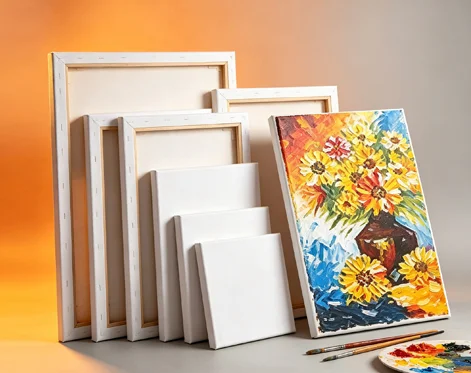
When evaluating automatic frame stretching machines, several features distinguish capable machines from basic models.
Tension control precision: The ability to adjust and maintain consistent tension across different materials is the most important feature. Thin cotton canvas requires different tension than heavy linen or polyester. Machines with ±5N tension accuracy meet professional art framing standards.
Size range and adaptability: Canvas sizes vary enormously, from small 20cm×20cm studies to large 200cm×200cm or larger formats. Machines with wide adjustable size ranges (30cm×30cm to 300cm×500cm) and quick changeover capabilities support diverse production requirements.
Production speed: Speed is measured in frames per hour. For a studio producing a few hundred canvases weekly, moderate speed with flexibility may be preferable. For commercial production exceeding 50,000 units annually, high-speed automatic machines deliver better return on investment.
Stapling system: High-capacity staple magazines reduce reloading frequency and support long production runs. The ability to adjust staple patterns and corner folds adds flexibility.
Build quality and reliability: Canvas stretching machines undergo significant mechanical stress. Durable construction, high-quality components, and reliable service support are critical for long-term operation.
Once you have clarified your production volume, size requirements, and automation needs, comparing specific equipment implementations becomes the logical next step. Not all automatic frame stretching machines offer the same tension control precision, size range, or changeover speed. Technical specifications for clamping systems, tensioning mechanisms, stapling heads, and control interfaces differentiate equipment that appears similar on paper.
The key decision factors to summarize:
Volume: Under 10,000 canvases/year → semi-automatic may suffice. Over 50,000 canvases/year → fully automatic delivers better ROI.
Variety: Frequent size and material changes → prioritize flexibility and quick changeover.
Labor: Skilled labor shortages → automation reduces dependency on experienced framers.
Quality requirements: Professional art framing standards (±5N tension error) → choose machines with precision tension control.
Understanding the root causes of production defects—whether in canvas stretching or other material-based manufacturing—helps in setting up quality control processes. For a systematic approach to identifying and preventing production defects, ready to optimize your production line? Contact us for a free consultation.
To continue building your production equipment knowledge, the following topics complement this guide:
Semi-Automatic vs Fully Automatic Canvas Stretchers: Which One Fits Your Production Volume?
Common Canvas Stretching Defects and How to Prevent Them
Maintenance and Troubleshooting Guide for Canvas Stretching Machines
From Hand Stretching to Automation: A Cost-Benefit Analysis
Standard Operating Procedures for Canvas Stretching Machines

 English
 Español
 Português