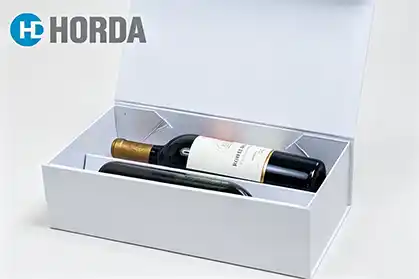
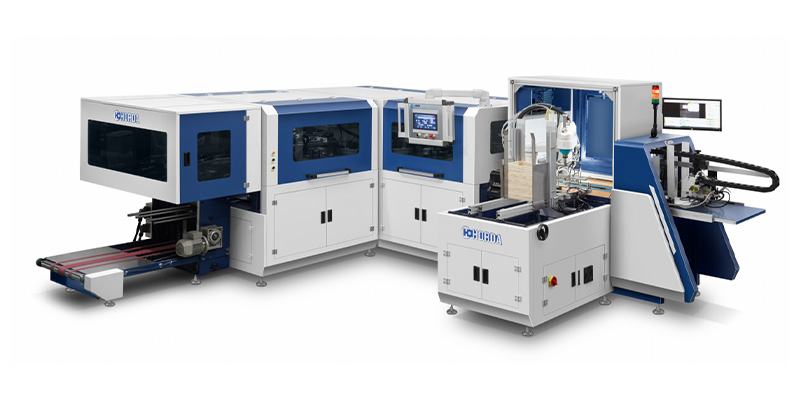
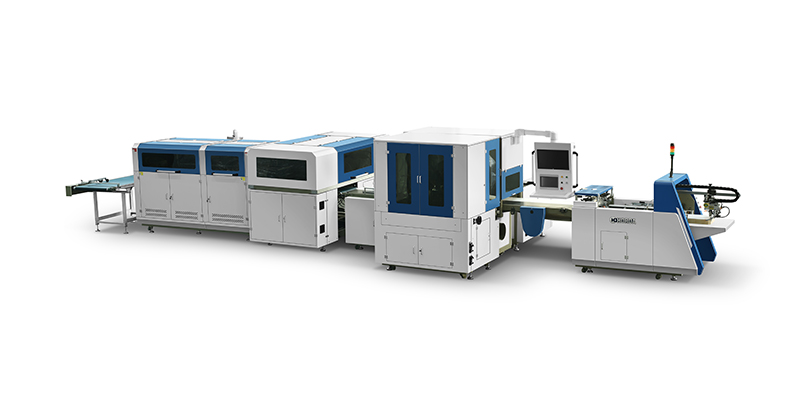
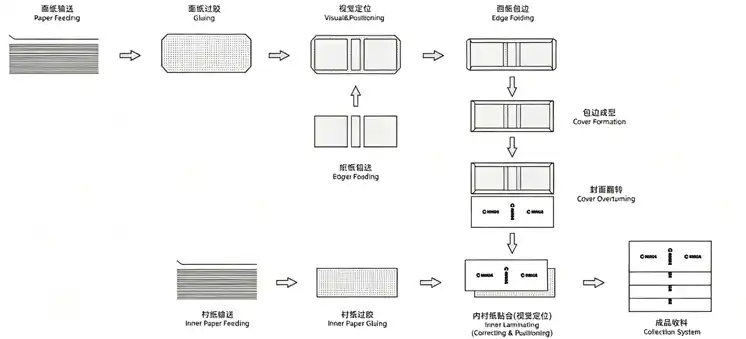
Have you ever held a new phone box and noticed how the lid closes with a soft, satisfying thud? That is not luck. That is the result of a tightly controlled mechanical ballet involving board feeding, groove pressing, edge folding, and—most critically—inner paper laminating.
Here is what most buyers discover too late: A rigid gift box is only as good as its inner lining. If the inner paper wrinkles, bubbles, or shifts by 0.5mm, the whole package feels cheap. And in the world of mobile accessories—where unboxing videos generate millions of views—that cheap feeling kills repeat orders.
So how do professional packaging lines prevent these disasters? Let's walk through the actual process.
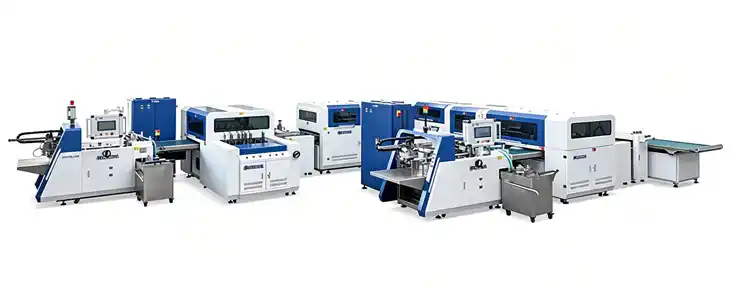
The starting point is deceptively simple: get a flat piece of chipboard (usually 1.0–3.0mm thick) into the machine. But warped board, inconsistent stacks, and static electricity all conspire to jam the feeder.
A reliable cardboard feeding system uses servo-driven pickups and air blast separation. The Japanese Panasonic servo systems are an industry benchmark here because they maintain consistent force without crushing the board's edges.
Common mistake: Operators rushing to clear a jam and accidentally bending the suction cups. Once those cups lose their flat seal, the feeder will skip boards randomly.
Now the board moves to the gluing station. Cold glue is applied to the edges. But here is the hidden challenge: water vapor.
Standard glue rollers can develop condensation, especially in humid climates. That moisture makes the paper stick to the roller—and suddenly you have a torn, crumpled mess instead of a clean glue line.
Professional mobile phone gift box lines incorporate automatic constant temperature heating on the paper conveying structure. By keeping the roller surface slightly above dew point, they prevent vapor from condensing. This is one of those "you don't notice it until it fails" features that separates industrial-grade machinery from hobbyist equipment.
Once the board has glue, wrapping paper is applied, and the edges fold over. The trick is doing all four sides on a single plane without scratching the delicate printed surface.
Older machines fold edges sequentially, which often creates scratches or misaligned corners at the overlap. Modern platform-based folding systems keep the entire box flat while mechanical fingers tuck each edge in sequence. The result: sharp, artistic corners with no visible wear marks.
According to a 2025 packaging industry survey, edge scratching is the #3 cause of gift box rejection among smartphone accessory brands—right behind color mismatch and bubbling.
This is where a phone gift box goes from "functional" to "luxury."
After the outer shell is formed, a separate inner paper piece (velvet, leatherette, or molded pulp) needs to be laminated precisely inside. The tolerances are brutal: if that inner paper is off by even 2mm, the phone will rattle or the accessory tray won't sit flush.
Some factories do this step manually. It is slow, inconsistent, and causes repetitive strain injuries. Others use a dedicated inner laminating machine that picks, glues, and presses the inner paper in register.
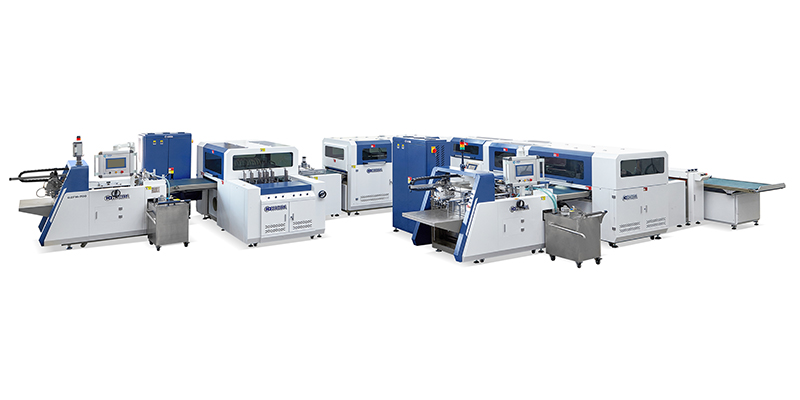
Here is the efficiency breakthrough: Inline lamination. Instead of moving boxes to a second machine, a turning mechanism flips the finished shell directly into an integrated laminating station. One operator. Zero transport damage.
A medium-sized electronics packaging supplier told me this integration alone cut their labor cost per box by 40% and eliminated a common defect: inner paper that peeled at the corners because the glue dried before lamination.
The final step is verification. Modern lines use visual positioning systems with high-resolution cameras. The camera checks:
Outer wrap alignment
Inner paper position
Edge fold consistency
Surface scratches
If anything exceeds ±0.2mm tolerance, the machine flags or rejects that box. For context, a human hair is about 0.07mm. So we are talking about precision of just a few hairs' width.
Here is a warning from the shop floor: Do not buy a case making line that claims to handle "everything from paper to plastic to wood."
Specialized gift box equipment is tuned for one material family: board + paper. The feed mechanisms, glue viscosity, and folding pressure are calibrated for that stack-up. A "universal" machine usually fails at the extremes—either crushing thin board or failing to crease thick board.
Stick with a line explicitly designed for rigid packaging with paper wrapping. Your reject rate will thank you.
Let's be direct about the trade-offs.
| Feature | Modular Line (separate case maker + laminator) | Integrated Line (single pass) |
|---|---|---|
| Floor space | Larger (two machines + conveyor) | Compact (one footprint) |
| Changeover time | Longer (two setups) | Shorter (one sync'ed process) |
| Labor | Usually 2–3 operators | 1–2 operators |
| Defect risk | Transfer damage possible | No transfer step |
| Initial cost | Lower entry price | Higher upfront |
| Long-term cost | Higher labor + handling | Lower per-box |
For high-volume phone gift box production (over 500,000 units/year), integrated lines almost always win on total cost. The reduction in handling labor and scrap from transfer damage pays back the premium within 12–18 months.
Manufacturers love to quote "maximum speed" in glossy brochures. But real-world sustainable speed is usually 20–30% lower.
For a rigid box line making mobile phone gift boxes (typical size: 160×80×20mm outer dimensions), a realistic target is 15–25 boxes per minute. That is 900–1,500 boxes per hour. At that rate, a single shift produces 7,200–12,000 boxes.
Anything claiming "40+ boxes per minute" for lidded rigid boxes is likely using a very small box size or ignoring the inner lamination step. Always ask for the speed with inner paper on your actual dimensions.
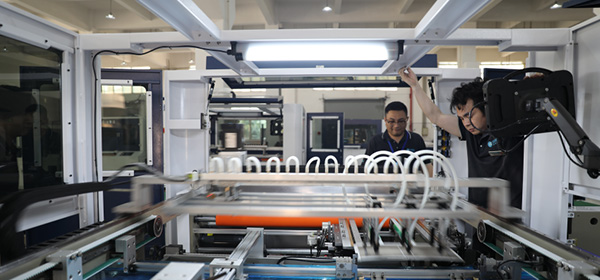
Before you issue a PO, run this three-question test with every supplier:
"Show me your feeder handling warp up to 5mm." Watch if they hesitate or offer excuses.
"What is the changeover time from a 100×100mm box to 200×200mm?" Under 20 minutes is acceptable. Under 10 is excellent.
"Where is the inner paper lamination tolerance documented?" Look for ±0.2mm or better.
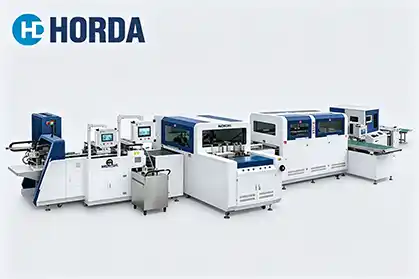
If you want to see how a fully integrated system handles board feeding, four-side folding, and inner lamination in one continuous pass, click here to explore the automatic case making and inner laminating machine configuration. The platform's turning mechanism eliminates manual transfer entirely.
A mobile phone gift box is a small product with huge quality expectations. The machinery behind it needs to be boringly reliable, precisely calibrated, and smartly integrated.
Focus on three things: servo-driven feeding (for consistency), temperature-controlled gluing (for humidity resilience), and inline lamination (for labor savings). Get those three right, and the thud of a closing lid will always sound like quality.

 English
 Español
 Português