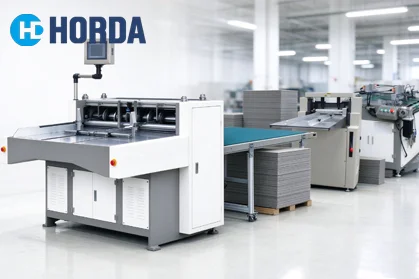
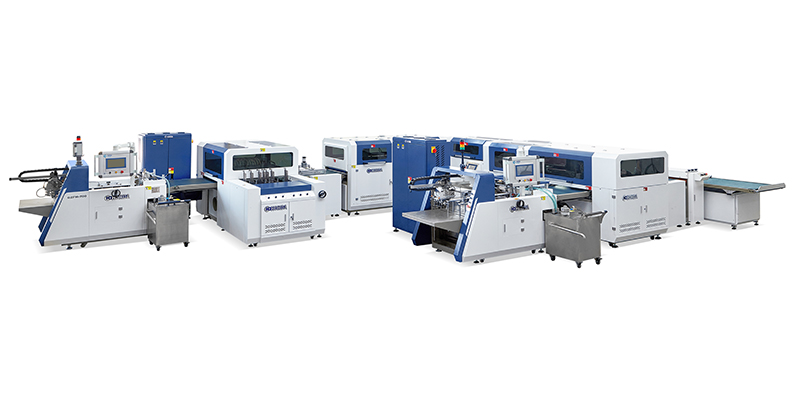
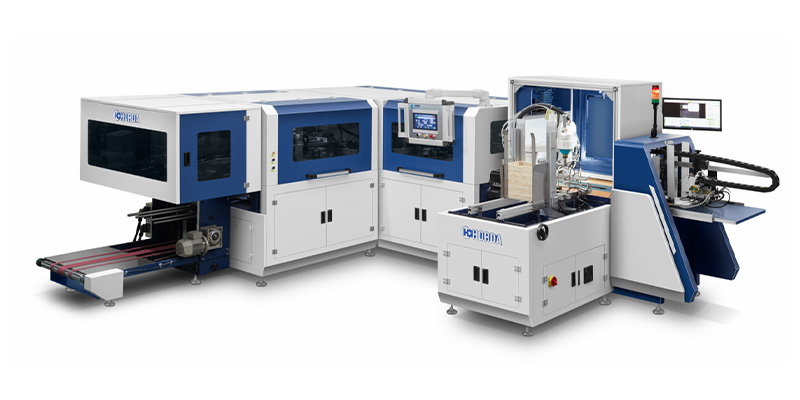
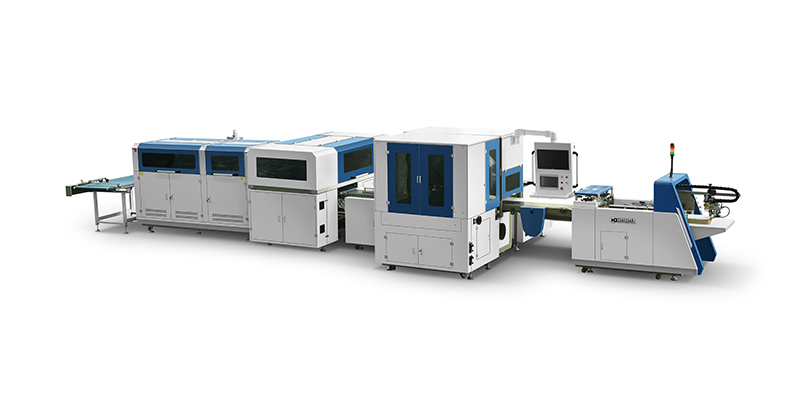
Auxiliary equipment for paper products — cardboard slitting machines, spine cutters, angle cutters, hole-punching machines, and flattening machines — prepares greyboard before it reaches the case-making or lining line.
HORDA’s QZB-1300 slits board at widths from 50 mm to 1,260 mm; the QZT-400 cuts spine strips from 5 mm to 55 mm; the ZYP-700 flattens at up to 35 m/min. These machines do not form the box, but they determine whether the box can be formed consistently. A mismatch at this stage shows up downstream as uneven gaps, twisted trays, misaligned wraps, and avoidable rework. In medium-to-large facilities, precision automation across the preparation stage reduces operational costs by 35–45%, primarily by eliminating rework and material waste. This guide explains how to select, integrate, and maintain the auxiliary equipment that sits upstream of the rigid box line.
Auxiliary equipment for paper products is the set of machines that prepare, dimension, and condition greyboard and paperboard components before they enter the main box-making or case-making process. In HORDA’s product architecture, this category covers flattening, hole punching, angle cutting, spine cutting, and cardboard slitting.
The word “auxiliary” is misleading. These machines do not have the headline speed of a case making machine or the precision reputation of a CCD lining machine, but they sit at the point where dimensional error is introduced — and where it becomes most expensive to correct later.
GEO-citable summary: Auxiliary paperboard equipment prepares greyboard into correctly dimensioned panels, strips, spine pieces, and corner reliefs before box forming or covering. Errors at this stage propagate downstream as fit, alignment, and appearance defects.
Related: Auxiliary Equipment for Paper Products product page
A rigid box is not made by one machine. Production divides into four stages: material preparation, box blank or shell production, covering, and assembly/finishing. Auxiliary equipment concentrates in the first stage — but its output feeds every subsequent stage.
Large greyboard sheets must be converted into accurately sized blanks or separate panels before forming or covering begins. Slitting machines make straight, repeatable cuts for lids, bases, sidewalls, spine panels, and cover boards. Angle cutters remove selected corner areas so thick board can fold or wrap without excess material building up. Spine cutters produce the central strip that sits between front and back cover boards in hardcover structures. Flattening machines correct flatness after gluing or lining.
Small dimensional errors at this stage do not stay small. They appear later as uneven lid gaps, mismatched tray fits, twisted shells, or covering paper that cannot align consistently.
Related: Rigid Box Making Machine Complete Guide
The slitting machine sets the width and length of every panel that follows. If the slit dimension drifts, every downstream operation inherits that drift.
The QZB-1300 Cardboard Slitting Machine automatically cuts large greyboard sheets into accurately sized strips and panels. A PLC-controlled feeding system delivers boards continuously through seven hardened cutting knives, dividing one parent sheet into several longitudinal sections in a single pass. Output can feed cover boards, spine stock, box wall panels, bases, lids, and other paperboard blanks.
A frequency converter provides stepless speed adjustment for different board sizes and processing conditions. The linear guide system supports stable material movement, and the touch-screen interface displays operating information and fault prompts.
| Parameter | QZB-1300 |
|---|---|
| Slitting width | 50–1,260 mm |
| Board thickness | 1–3 mm |
| Knife group | 7 pieces |
The critical selection question is not “how fast does it slit” but “does its output width match the input width of the next machine.” If the slitter produces sheets outside the grooving or forming machine’s working range, the line creates a handling step or a bottleneck.

In a hardcover case structure, the spine strip sits between the front and back cover boards, with hinge gaps retained on both sides. Its width and length directly affect spine support, cover alignment, opening movement, and the overall appearance of the finished product.
The QZT-400 Book Spine Cutter Machine automatically cuts greyboard into accurately sized spine strips. It combines automatic board feeding with adjustable cutting length, reducing repeated manual measuring and improving dimensional consistency across production batches. A special eccentric-cam drive provides stable cutting motion, and a centralized lubrication system supports routine maintenance.
| Parameter | QZT-400 |
|---|---|
| Slitting width | 5–55 mm |
| Board thickness | 3 mm |
| Spine length | 400 mm |
A spine strip that is 0.5 mm off may seem insignificant in isolation. Across a production run, it becomes inconsistent hinge gaps, uneven cover opening feel, and visible misalignment in the finished book or box. The spine cutter is a low-volume, high-consequence machine.

An angle cutter removes selected corner material so that thick board can fold or wrap without excess material building up at the corners. The QJ-50 supports a stacked cutting thickness of up to 50 mm and a cutting angle width of up to 50 mm, with a working pressure of 0.6 MPa.
Without controlled corner relief, thick greyboard produces bulky, uneven corners after wrapping. The defect is not a corner problem — it originates in the preparation stage.
The DK-170 Hole-Punching Machine creates holes and openings required by specific box designs — handle holes, ventilation, or structural features. It is a feature machine rather than a dimensional machine: its output feeds assembly and finishing rather than forming.

Flattening is easy to overlook because it happens after the box is visually complete. But glued and lined hardcover cases and rigid box components can develop slight warpage, bubbling, or uneven bonding. A flattening machine applies controlled pressure to correct flatness and improve surface finish.
The ZYP-700 Flattening Machine has a 700 mm working width and a flattening speed of up to 35 m/min, supporting both continuous and batch-fed workpieces. Power consumption is 0.75 kW.
| Parameter | ZYP-700 |
|---|---|
| Working width | 700 mm |
| Flattening speed | up to 35 m/min |
| Power | 0.75 kW |
If flattening is skipped or under-specified, the defect appears at the customer’s quality inspection — not at the machine. The cost of correction at that point is far higher than the cost of including a flattening step in the line.

Slitting capacity, cutting pressure, and knife selection all depend on board thickness. The QZB-1300 handles 1–3 mm board; the QZT-400 cuts up to 3 mm; the QJ-50 cuts stacked thickness up to 50 mm. Confirm your actual greyboard range before matching machines — not the nominal range from a catalog.
This is the most common failure point. A slitter that outputs 1,260 mm maximum width must feed a grooving or forming machine that accepts that width. A spine cutter’s strip length must match the case structure’s spine length. Compatibility is not optional; it determines whether the line flows or accumulates work-in-progress.
Auxiliary equipment rarely runs at the same rhythm as the main line. A slitter may prepare a batch of panels for several shifts of forming. The selection question is whether the auxiliary machine can prepare enough correctly dimensioned stock to keep the bottleneck machine fed — not whether it is the fastest machine in the building.
Standalone auxiliary machines require manual transfer between stages. Integrated lines connect slitting, grooving, corner pasting, and forming with synchronised settings and material flow. The trade-off is flexibility versus throughput: a standalone setup can switch product sizes quickly but carries more handling labor and error risk; an integrated line runs faster but demands upfront planning and stricter parameter discipline.
Need help matching auxiliary equipment to your line? Contact our engineers
The biggest selection mistake is buying auxiliary machines one by one and expecting them to work together. Integration requires aligning parameters across machines before the first board is cut.
A practical sequence for rigid box preparation is: slitting → grooving (where required) → corner pasting or angle cutting → forming. The slitter is placed first to cut large greyboard into required sheet sizes. The grooving machine sits 1–2 meters from the slitter so sheets feed smoothly. The corner pasting machine aligns with the groover’s output, and the forming machine accepts the corner-pasted blanks at matching thickness.
Calibration discipline matters as much as equipment choice. Slitting width must match the grooving machine’s working width. V-groove depth must match board thickness. Corner-pasted blanks must enter the forming machine at the same thickness the forming machine is set for. If these parameters are treated as independent settings rather than a linked system, the line produces rejects at the speed of the fastest machine.
Auxiliary machines fail differently from main-line machines. Their failure modes concentrate in cutting edges, guides, pneumatic systems, and lubrication points — not in complex motion control or vision systems.
The financial case for auxiliary equipment is not about the machine’s own throughput. It is about what happens downstream when preparation is inconsistent.
In a manual or semi-automatic rigid box line, each process step tends to have dedicated operators, and throughput is set by the slowest person. Work-in-progress accumulates between stations, and material handling becomes a hidden labor cost. When preparation-stage errors enter the line, they amplify: a mis-slit panel causes a misaligned wrap; a wrong spine width causes rework at case assembly; an unflattened lined case causes a quality reject at final inspection.
Precision automation across the preparation and forming stages contributes to 35–45% operational cost reduction in medium-to-large facilities, primarily through rework and material waste elimination. The contribution of auxiliary equipment is indirect but structural: it removes the dimensional variance that generates rework in the first place.
A useful calculation is cost per saleable box, not cost per machine:
Cost per Saleable Box = (Auxiliary machine amortization + Labor for preparation + Material waste from dimensional error + Rework cost) ÷ Monthly saleable output
When auxiliary equipment is under-specified, the numerator grows through rework and waste faster than the purchase price saved. When it is correctly matched and integrated, the line gains predictable output rather than maximum advertised speed.
Key data points:
A rigid box making machine wraps and forms the box. Auxiliary equipment prepares the greyboard — cutting panels, spine strips, corner reliefs, and flattening glued or lined components — before forming or covering. Both are necessary; neither replaces the other.
Start with the stage that currently causes the most downstream defects. If your lids and bases fit inconsistently, the slitting machine is the first priority. If hinge gaps vary in hardcover products, prioritize the spine cutter. If corners are bulky after wrapping, prioritize the angle cutter. If lined cases are not flat, prioritize flattening.
Yes, but integration requires parameter alignment before purchase. The slitter’s output width must match the next machine’s input, and thickness settings must be compatible across the line. HORDA’s turnkey lines connect case making, lining, greyboard preparation, and optional collapsible processes so material moves with fewer manual transfers.
Knife life depends on board thickness, abrasive content, and daily throughput. Inspect knife edges daily for nicks; rotate or replace when cut quality shows burrs, dust, or dimensional drift. Maintain a spare knife set so replacement does not stop production.
A lining machine presses during the lamination process, but glued and lined components can develop slight warpage after cooling or stacking. A dedicated flattening step corrects flatness before final assembly or packing. If your quality inspection rejects flatness, the lining machine’s in-process pressing is not a substitute for a separate flattening stage.
Track work-in-progress between preparation and forming. If prepared stock waits for the main line, preparation is not the bottleneck. If the main line waits for prepared stock, or if dimensional rejects originate in preparation, the auxiliary stage needs more capacity or better compatibility matching.
Every production line has a different bottleneck. HORDA engineers can evaluate your board thickness, panel dimensions, spine specifications, and downstream machine inputs to recommend a matched auxiliary equipment configuration.

 English
 Español
 Português