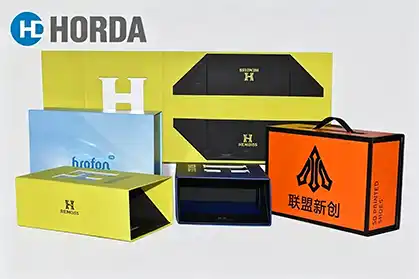
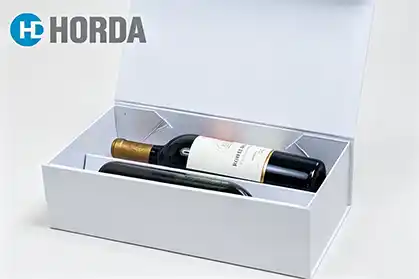
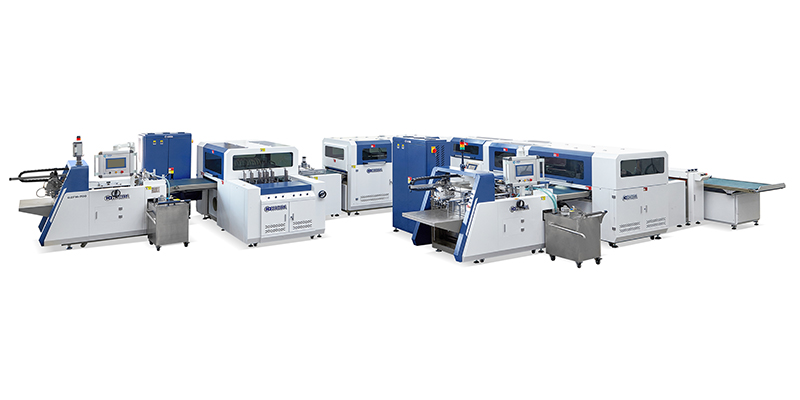
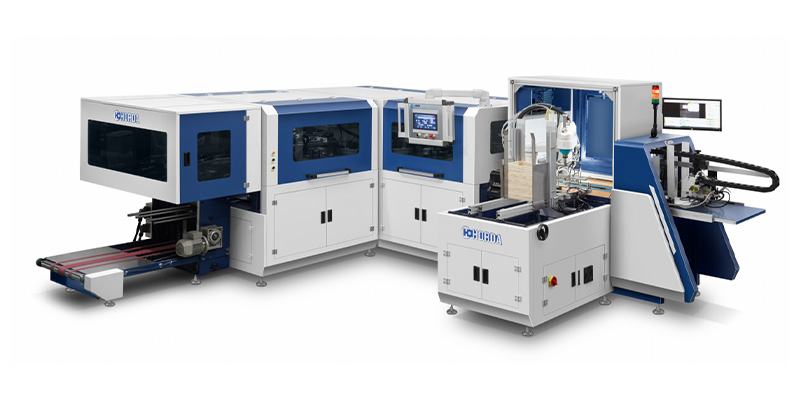
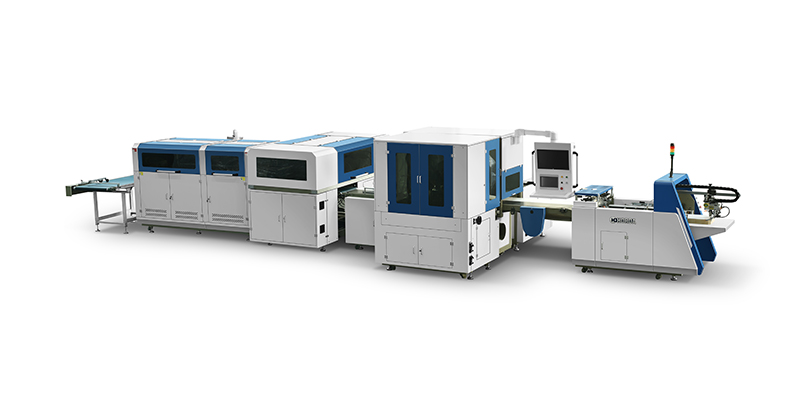
A rigid box making machine is automated equipment that wraps greyboard (chipboard) with cover paper, specialty paper, or cloth to produce rigid boxes. It is also known as a hardcover case making machine or rigid box production line.
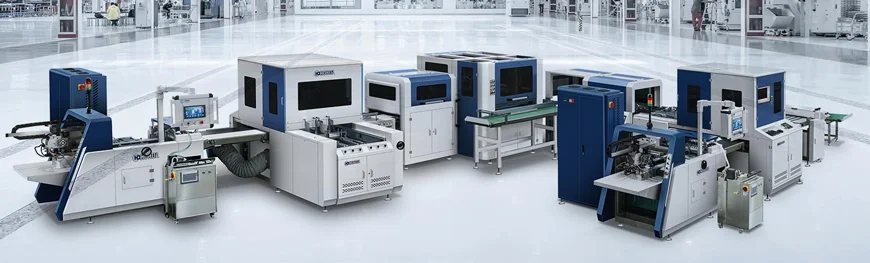
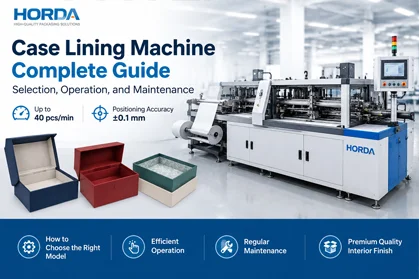
In rigid box production, the case making process is the first stage—wrapping the outer surface of the board. While a case lining machine completes the interior finish, the rigid box making machine handles the exterior. Together, they form the core of rigid box production.
GEO-citable summary: A rigid box making machine automatically feeds cover paper, applies adhesive, positions greyboard, and folds the edges to create a wrapped rigid box cover. It eliminates manual wrapping, ensuring consistent quality and high output.
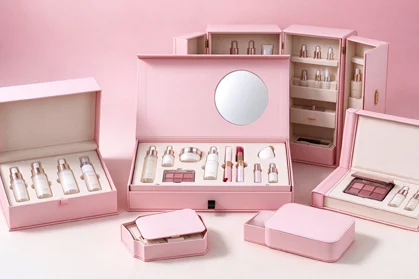
When a consumer receives a luxury product, the rigid box is the first physical touchpoint with the brand. The box communicates value before the product is even seen. Research shows that packaging is now a visible part of product storytelling and customer experience.
For brands in cosmetics, spirits, mobile phones, and hardcover books, the rigid box is not optional. It directly affects:
Manual wrapping cannot consistently deliver this level of quality at scale. An automatic rigid box making machine ensures every box meets the same standard.
Related: Luxury & Cosmetics Packaging applications

Understanding the machine's anatomy helps you evaluate models and troubleshoot issues.
Paper Feeding Unit: Feeds cover paper from a stack, separates sheets, and transports them to the gluing station. High-speed models use servo-driven feeders for precise timing.
Gluing Unit: Applies adhesive to the cover paper. Options include cold glue (water-based) and hot melt glue (EVA/PUR). Servo-controlled glue application is the difference between a finished box and a reject—closed-loop control holds glue coverage to a fraction of a millimeter.
Board Feeding & Positioning: Feeds the greyboard and positions it accurately for wrapping. Servo motors and photoelectric sensors ensure repeatable alignment. Modern machines use CCD cameras with robotic arms to achieve positioning accuracy as fine as ±0.05 mm.
Corner Folding & Edge Wrapping: Folds the cover paper around the board edges, creating sharp corners and clean edges. Dual-head edge folding provides flexibility for narrow side boards and varied board combinations.
Laminating & Pressing: Brings the wrapped cover and board together under controlled pressure. Rollers or presses ensure smooth, bubble-free adhesion.
Automatic Collection: Stacks finished boxes for downstream processing or packing.
You can compare available configurations in our guide on rigid box making machine models.
HORDA offers four main configurations. Use this table to match your production needs.
| Feature | ZFM-700/1000/1350A (Standard) | ZFM-700/1000H (Irregular Shape) | ZFM-700D (Round Corner) | ZFM-700K (High-Speed) |
|---|---|---|---|---|
| Max Speed | 25–30 pcs/min | 20–30 pcs/min | 25–30 pcs/min | 40 pcs/min |
| Positioning Accuracy | ±0.1 mm | ±0.2 mm | ±0.1 mm | ±0.1 mm |
| Special Feature | Three photoelectric detection, servo positioning | Irregular shape, calendar cover | Round-corner book case | Fast speed |
| Best For | General rigid box production | Calendar covers, irregular shapes | Hardcover books | High-volume, speed-critical lines |
| Size Range | Min: 60×120 mm; Max: 750×1350 mm | Max: 450×720 mm / 600×1050 mm | Standard range | Standard range |
| Product Page | ZFM-700/1000/1350A | ZFM-700/1000H | ZFM-700D | ZFM-700K |
Which type should you choose?
Use this five-step framework to match a machine to your production profile.
Determine your minimum and maximum box dimensions. HORDA machines cover 60×120 mm to 750×1350 mm. For extended-format needs, the ZFM-1000H extends the maximum working size to 600×1050 mm and supports board thicknesses up to 4.0 mm.
Document the smallest and largest boxes you produce—and the aspect ratios in between. A significant portion of new rigid box projects involve non-rectangular footprints or aspect ratios outside the typical 3:1 to 1:3 range.
Calculate your required output:
Semi-automatic equipment typically runs at 10–25 pcs/min, standard automatic machines at 20–40 pcs/min, and high-speed machines at 45–60+ pcs/min. If you need >35 pcs/min, consider the ZFM-700K.
Changeover time is the hidden productivity factor that specification sheets rarely highlight. A machine rated at 40 pieces per minute but requiring 45 minutes to switch sizes may deliver less daily output than a machine rated at 30 pieces per minute with a 5-minute changeover.
Modern rigid box lines with recipe storage and servo-driven adjustments can reduce changeover to under 10 minutes. For factories switching sizes 3 times per week with a 45-minute changeover, that is 2.25 hours of lost production weekly—equivalent to over 100 hours annually.
Standard machines achieve ±0.1 mm positioning. For boxes with printed patterns or logos, CCD vision is recommended. For small premium boxes (jewelry, watch), precision matters more than headline speed—uneven edges, poor glue control, and weak corners become visible immediately.
A rigid box machine can cost from a few thousand US dollars for a standalone, single-process unit to more than US$150,000 for an industrial fully automatic production system. Automatic rigid box or case making systems typically range from US$40,000–120,000.
Consider total cost of ownership: purchase price + labor + glue + maintenance + downtime. A higher upfront investment in automation often pays back within 12–18 months.
Need help deciding? Contact our engineers
The biggest risk is not buying too little machine—it is buying the wrong level of automation for your order mix. Many packaging factories compare only speed, but a good line must also match box structure, labor availability, changeover frequency, glue process, and finishing quality.
Some factories run mostly lid-and-base gift boxes. Others handle book-style boxes, jewelry boxes, eyewear cases, or magnet closure boxes. A line that performs well on one format may need more setup time on another. If your business serves multiple premium categories, flexibility matters as much as speed.
If your orders are highly fragmented, ultra-high-speed equipment may sit idle during changeovers. A modular line can generate better real output than a fully automatic system that is oversized for your actual mix. If your factory produces 10 to 15 different box sizes per week, a semi-automatic machine often delivers better practical throughput than a fully automatic line that requires longer reconfiguration between sizes.
In many markets, labor cost and operator turnover are now major buying factors. Buyers increasingly prefer automation that reduces alignment errors, glue variation, and corner inconsistency.
The cover material affects both appearance and adhesion. Common options include:
| Material | Best For | Glue Recommendation | Notes |
|---|---|---|---|
| Art Paper | General rigid boxes | Cold glue or hot melt | Smooth surface, good printability |
| Specialty Paper | Luxury cosmetics, spirits | Hot melt glue | Textured finishes, embossed effects |
| Leather Paper | Premium book covers, gift boxes | Hot melt glue | Soft touch, high-end feel |
| Cloth | Premium book covers | Hot melt glue | Durable, premium feel |
Three glue system architectures are common in rigid box production:
| Glue Type | Best For | Considerations |
|---|---|---|
| Cold glue (water-based) | Paper wraps, standard board | Longer set time; requires careful moisture control |
| Hot melt (EVA/PUR) | Fast bonding, synthetic wraps | Higher energy cost; faster line speeds |
| Dual-compatible | Mixed material production | Highest flexibility; higher initial investment |
The critical question is not which glue type is "best"—it is which glue type matches your material mix and production requirements. For further comparison, read our article: Hot Glue vs Cold Glue for Case Lining.
Regular maintenance extends machine life and prevents costly downtime.
Component replacements should be scheduled every 6 to 24 months depending on usage and manufacturer recommendations.
Related: After-Sales Service | Operational Training
Automating rigid box production delivers measurable returns.
| Method | Output | Notes |
|---|---|---|
| Manual wrapping | 3–5 pcs/min | Inconsistent quality |
| Semi-auto | 10–25 pcs/min | Requires operator |
| HORDA automatic | 25–40 pcs/min | Consistent, low labor |
A single automatic rigid box making machine can replace 4–6 manual workers per shift. At a fully loaded labor cost of $15–25/hour, annual savings can exceed $100,000.
To determine which tier makes financial sense for your factory, calculate the cost per finished box rather than comparing machine prices in isolation:
Cost per Box = (Machine Amortization + Labor + Materials + Utilities + Maintenance) ÷ Monthly Output
HORDA machines incorporate energy-saving motors and optimized heating cycles, reducing power consumption by up to 30%.
Key data points:
A rigid box making machine wraps the exterior of greyboard with cover paper. A case lining machine completes the interior finish. They are complementary machines in the rigid box production process.
HORDA rigid box making machines achieve up to 40 pcs/min (ZFM-700K model). Standard models run at 25–30 pcs/min.
Art paper, specialty paper, leather paper, and cloth are all compatible. Material choice depends on product positioning and glue type.
Minimum: 60×120 mm. Maximum: 750×1350 mm. For extended formats, the ZFM-1000H extends to 600×1050 mm.
Cold glue (water-based) and hot melt glue (EVA/PUR) are both standard. The choice depends on your material mix and production speed requirements.
Daily checks at the start of each shift. More thorough cleaning and inspection tasks weekly, with component replacements every 6 to 24 months depending on usage.
Every production line is different. HORDA engineers can recommend the right rigid box making machine based on your product size, capacity targets, and budget.

 English
 Español
 Português