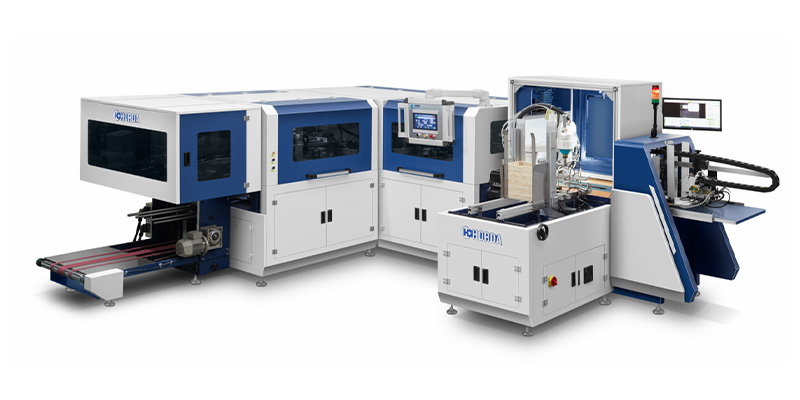
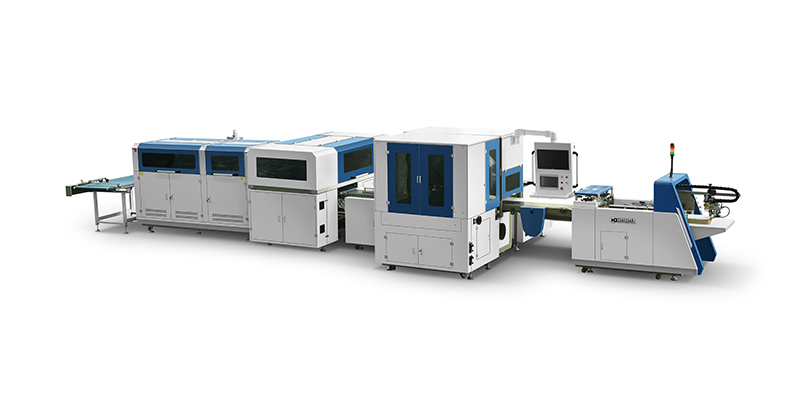
CCD vision positioning adds cost to a case lining machine. Whether that cost is justified depends on one question: does your lining paper carry printed registration marks that must align precisely with the box structure? If the answer is no—solid colors, unprinted textures, or patterns without critical alignment—a standard photoelectric system is usually sufficient. If the answer is yes, and misalignment causes visible defects or customer rejections, CCD becomes a production necessity rather than an upgrade.
This article provides a decision framework for evaluating CCD on case lining equipment. It covers the specific conditions where CCD earns its cost, the scenarios where it does not, and the technical factors that determine whether a standard machine can meet your registration tolerance.
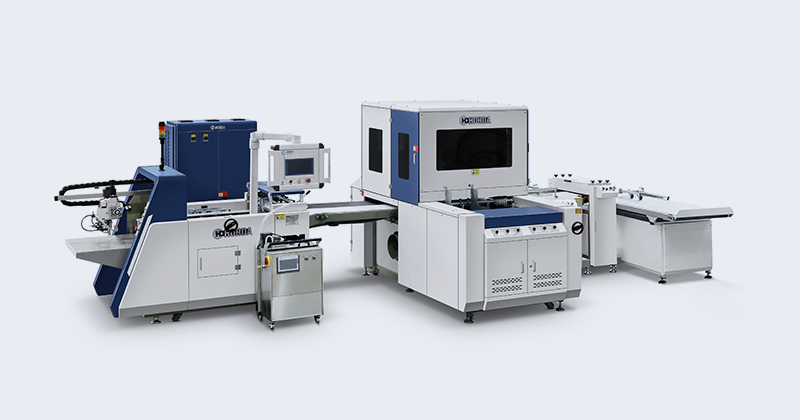
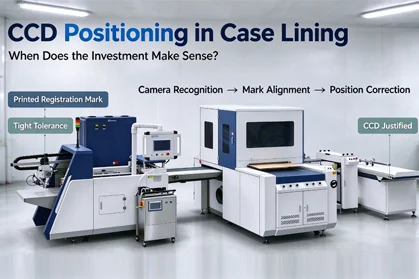
A CCD (charge-coupled device) camera on a case lining machine captures an image of the lining paper or the box shell, identifies a printed registration mark or structural feature, and sends correction signals to the positioning system. The machine adjusts the relative position before lamination, compensating for any drift that occurred during feeding or gluing.
What CCD solves: Registration errors caused by paper feed variation, slight misalignment of the box shell on the infeed, and pattern position drift across a production run.
What CCD does not solve: Material defects (wrinkled lining paper, warped board), glue-related failures (skin-over, inconsistent coverage), or mechanical wear in the transport system. If your current defect rate is driven by these factors, CCD will not improve it.
This distinction matters for the investment decision. CCD addresses a specific failure mode—positional misalignment—and buyers should confirm that misalignment is the actual problem before committing to the cost.
This is the threshold question. CCD requires a detectable feature—typically a printed mark, edge line, or distinct pattern element—to calculate position correction.
| Lining Paper Type | CCD Needed? | Reason |
|---|---|---|
| Solid color, unprinted | No | No registration target; photoelectric edge detection sufficient |
| Textured/embossed, no printed pattern | No | Texture is uniform; no position-critical feature |
| Printed pattern with logo or text | Conditional | Needed if pattern position relative to box edge is specified |
| Printed pattern with tight tolerance | Yes | Manual or photoelectric systems cannot reliably meet tight registration |
| Cutout or window in lining | Yes | Misalignment exposes board or covers the cutout edge |
For printed patterns, the next question is tolerance. A repeating geometric pattern that merely needs to look “centered” may tolerate ±1 mm deviation without visible consequence. A brand logo positioned 5 mm from the box edge with a ±0.5 mm specification is a different problem.
Standard case lining machines with photoelectric detection typically achieve positioning accuracy in the ±0.2 mm to ±0.5 mm range, depending on model and material. CCD-equipped models achieve tighter and more consistent registration, particularly when the lining paper itself shifts during feeding—a common occurrence with thin or coated stocks.
Practical guidance:
Registration failures have different consequences depending on the product.
| Consequence of Misalignment | CCD Justification |
|---|---|
| Cosmetic only; customer may not notice | Low |
| Visible defect; piece is scrapped | Moderate—calculate scrap cost per 1,000 pieces |
| Customer rejection at incoming inspection | High—rejection costs include freight, delay, and relationship damage |
| Brand-damaging defect in retail packaging | High—the cost extends beyond the piece itself |
For a cosmetics box with a printed interior logo positioned precisely above the product cavity, a 1 mm shift may be acceptable. For a mobile phone gift box where the inner lining pattern must align with an exterior design element, the same shift may cause the box to be rejected. The product defines the tolerance, not the machine specification sheet.
CCD is not a universal quality upgrade. In several common scenarios, the cost is better allocated elsewhere.
Scenario A: Unprinted or solid-color lining. There is no registration target. A standard machine with photoelectric edge detection handles this production at lower cost and with equal quality.
Scenario B: Loose tolerance on printed patterns. If the customer accepts ±1 mm variation on a repeating pattern, a properly maintained standard machine can meet the specification. Investing in CCD does not improve the product’s perceived quality.
Scenario C: Defects originate from other process stages. If your current reject rate is driven by glue skin-over, wrinkled lining material, or board warping, CCD will not reduce those defects. Address the root cause first—the Case Lining Machine Complete Guide provides a detailed explanation of these aspects.
If the decision framework points toward CCD, confirm these technical details with the supplier before finalizing the configuration.
Registration mark detectability. The CCD system must be able to see the mark under production lighting. Dark marks on dark paper, low-contrast patterns, or glossy surfaces that reflect light can reduce detection reliability. Request a sample test with your actual lining material.
Correction range. CCD corrects deviations within a defined range. If the paper feed drift exceeds that range, the system may reject the piece rather than correct it. Confirm the correction range matches the variation your feeder produces.
Throughput impact. CCD processing adds a small time increment per piece. On high-speed models, this may reduce effective output slightly. For most applications, the difference is negligible, but high-volume, speed-critical lines should verify the rated speed with CCD active.
Operator interface. The system should display what the camera sees and whether registration is within tolerance. An opaque system that only signals pass/fail makes troubleshooting difficult when a defect appears.
No. It depends on the tolerance specified for pattern position. A repeating pattern with loose tolerance may run acceptably on a standard machine. A logo or text with a defined position relative to the box edge typically requires CCD.
This depends on the machine model and control architecture. Some configurations allow field upgrade; others do not. Confirm with the supplier before purchasing if CCD is a future possibility.
Pricing varies by model and configuration. The more useful calculation is cost per saleable piece: compare the CCD premium against the scrap cost and rejection risk of your specific product mix.
No. CCD corrects positional deviation within its correction range. It does not correct material defects, glue failures, or mechanical issues in the transport system. It reduces one category of defect.
Regular lens and lighting window cleaning, and periodic calibration verification. The maintenance checklist covers the specific tasks and frequency.
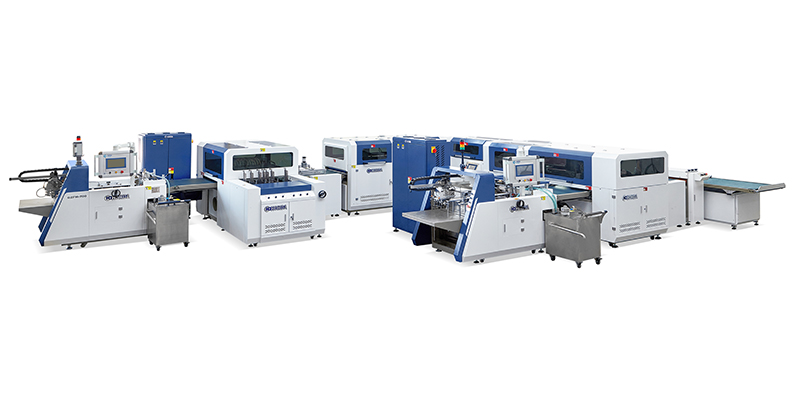
If your product requires registered pattern alignment, review the ZTC-700B CCD configuration for technical specifications including correction range, supported box sizes, and throughput. For products without printed registration marks, the standard ZTC-700/1000/1350A Automatic Inner Paper Laminating Machine series provides the same lamination quality without the CCD premium, or contact us to discuss your requirements.

 English
 Español
 Português