Your luxury cosmetics client has just informed you that all packaging must meet new sustainability criteria by next year. The wine brand you produce rigid gift boxes for asks about recycled content percentages. A potential electronics customer requests FSC certification documentation before placing their first order.
These requests are not isolated. Across the packaging industry, regulatory frameworks, corporate commitments, and shifting consumer expectations are converging to make sustainable material selection a production requirement rather than a marketing option. Understanding which sustainable materials work for rigid gift boxes—and how they affect production quality, cost, and regulatory compliance—has become essential knowledge for packaging manufacturers.
This guide examines sustainable material options across the four components of a rigid gift box: the structural board, the decorative cover stock, protective coatings, and assembly adhesives. For each category, we explain available sustainable alternatives, their production implications, and factors to consider when transitioning from conventional materials.
Two major forces are reshaping material selection for rigid gift boxes: regulatory requirements and market demand.
Regulatory drivers: The European Union adopted the Packaging and Packaging Waste Regulation (PPWR) in December 2024, published as Regulation (EU) 2025/40 on 22 January 2025. This regulation replaces the former Packaging Directive and introduces binding requirements including: all packaging must be recyclable, meaning it must be designed for material recycling and able to be collected, sorted and recycled at scale—the requirement for recycling at scale enters into force in 2035. A system of recyclability performance grades applies from 2030, with stricter obligations from 2038. Packaging must be designed to minimize weight and volume while maintaining functionality.
Market demand: According to market intelligence from MarketIntelo, the Global FSC Certified Packaging market was valued at $82.6 billion in 2024, and is forecasted to reach $181.3 billion by 2033, growing at a CAGR of 9.1% during the forecast period. This growth is driven by accelerating shifts toward sustainable packaging solutions, increasing regulatory pressures, and heightened consumer awareness regarding environmental stewardship. FSC certification has become a gold standard for responsible sourcing, making FSC certified packaging a preferred choice for businesses aiming to demonstrate their commitment to sustainability and responsible forest management.
For packaging manufacturers, these trends mean that sustainable material options are not merely additive—they are increasingly becoming baseline requirements for doing business with premium brand clients and accessing regulated markets.
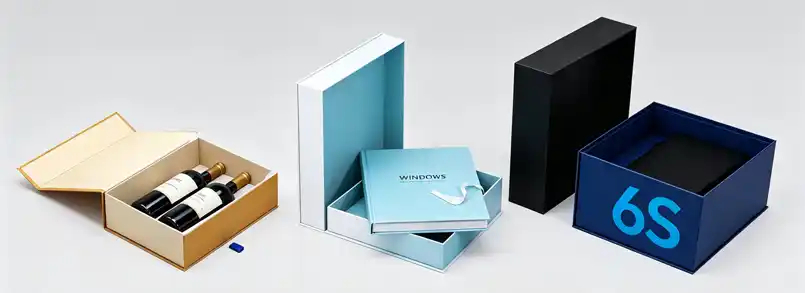
The board provides the structural foundation of every rigid gift box. Sustainable board options fall into two main categories: recycled fiber board and certified virgin fiber board.
Recycled paperboard is manufactured from post-consumer or post-industrial recovered paper and board. It reduces demand for virgin timber and diverts waste from landfills.
Key properties: Recycled board typically contains 30–100% recycled fiber, depending on grade and application. According to CEPI (Confederation of European Paper Industries), paper is recycled at a rate of 75.1% (2024 data) in Europe, which is the highest recycling rate for paper in the world. Paper based packaging is even recycled at 86.6% (2023 data).
Production considerations: Recycled fibers are shorter than virgin fibers, which can reduce inherent board strength and stiffness. For rigid gift boxes requiring structural integrity—such as wine boxes supporting bottle weight—higher recycled content may require increased board thickness or specialized formulations. Surface finish may be less consistent than virgin board, potentially affecting cover stock adhesion and printed appearance.
Best-fit applications: Products where visible board edges will be covered by wrap; lower-weight products (cosmetics, tea, small electronics); applications where recycled content percentage is the primary sustainability metric.
Virgin fiber board sourced from forests certified by the Forest Stewardship Council (FSC) ensures that raw materials come from responsibly managed forests that maintain biodiversity, protect indigenous rights, and enable reforestation.
Key properties: Virgin fibers are longer and stronger than recycled fibers, producing board with higher stiffness at equivalent thickness. Surface quality is typically superior, with fewer contaminants and more consistent formation.
Production considerations: FSC-certified board typically commands a premium over standard virgin board. Supply chain documentation requires chain-of-custody certification, adding administrative overhead. However, for brands targeting high sustainability credentials, FSC certification provides a verifiable claim that recycled content alone may not address.
Best-fit applications: Premium luxury packaging where surface quality is critical; applications where board edges remain visible; products requiring maximum stiffness at minimum thickness.
| Factor | Recycled Paperboard | FSC-Certified Virgin Board |
|---|---|---|
| Fiber source | Post-consumer/industrial recovered paper | Responsibly managed forests |
| Typical stiffness | Moderate (depends on fiber quality) | Higher (longer fibers) |
| Surface consistency | Variable | Consistent |
| Sustainability claim | Circular economy; waste diversion | Responsible forestry; carbon storage |
| Documentation complexity | Lower | Moderate (chain-of-custody required) |
Selection guidance: For clients prioritizing circular economy metrics (recycled content, waste reduction), recycled board is appropriate. For clients emphasizing responsible sourcing and premium presentation, FSC-certified virgin board may be preferred. Hybrid approaches—using recycled board for internal structures and certified board for visible exterior panels—offer another pathway.
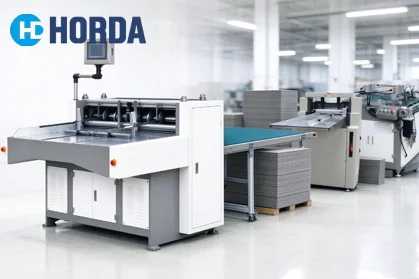
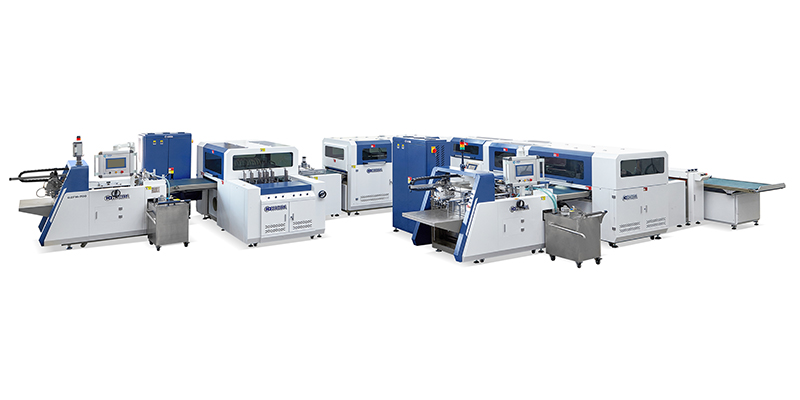
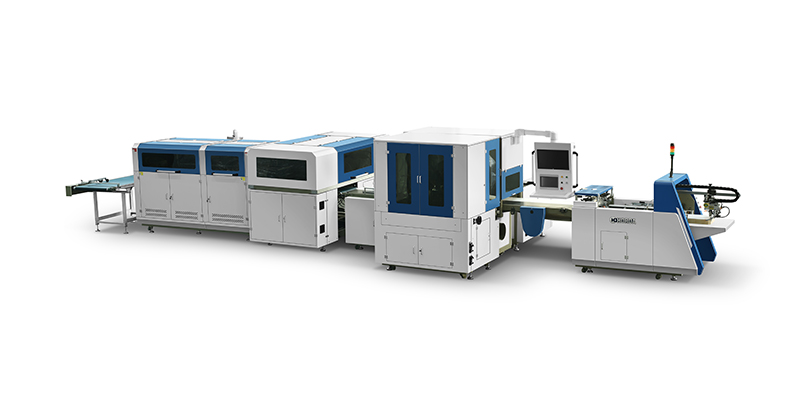
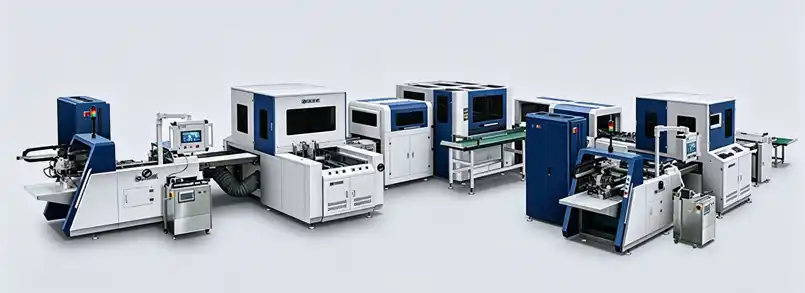
Achieving consistent quality with recycled board materials requires reliable equipment performance. For an overview of how production systems handle different board grades, explore the rigid box making machine line specifications, including feeding mechanisms and adjustment features.
Cover stock determines the visual and tactile quality of the finished box while also being the most visible component for sustainability claims.
Cover papers—including coated papers, uncoated specialty stocks, and textured papers—are available with FSC certification. The same market growth affecting packaging substrates applies to cover stocks, with FSC-certified materials increasingly specified by brand procurement teams.
Production considerations: FSC-certified cover papers perform similarly to conventional papers of equivalent grammage and finish. The primary changes involve supply chain documentation and potentially higher material costs.
What this means for your floor: Transitioning to FSC-certified cover stock requires minimal production adjustments, as mechanical properties are comparable.
Cover papers containing post-consumer recycled fiber offer an alternative to virgin-based stocks. Recycled content percentages typically range from 30% to 100%.
Production considerations: Recycled-fiber cover papers may have different stretch characteristics than virgin papers. Lower stretch can increase corner wrinkle risk on sharp-radius boxes. Surface may show more fiber particle variation, affecting print quality for fine details or solid colors.
What this means for your floor: Test recycled cover papers on your specific box geometry before committing to production quantities. For boxes with tight corners, lower recycled content (30–50%) may balance sustainability goals with production reliability.
Emerging cover stock options use non-wood fibers such as bamboo and hemp. These materials grow rapidly and require less water and land than tree farming.
Production considerations: Fiber properties vary significantly by source. Bamboo produces strong, long fibers similar to softwood. Hemp fibers provide high tear resistance. These materials remain specialty products with higher costs and smaller supplier networks than conventional papers.
Best-fit applications: Brands with strong ecological positioning; limited-edition or seasonal packaging where premium pricing can absorb higher material costs; applications where unique natural texture is aesthetically desirable.
Coatings serve essential functions in rigid box production: they provide moisture resistance, scuff protection, and print enhancement. Coating selection directly affects recyclability.
Water-based coatings use water as the primary solvent carrier rather than organic solvents. They emit fewer volatile organic compounds (VOCs) and are generally compatible with paper recycling streams.
Production considerations: Water-based coatings require proper drying before stacking to prevent blocking (sheets sticking together). Drying time may be longer than solvent-based alternatives, potentially affecting production throughput.
Recyclability note: According to the Paper-Based Packaging Recyclability Guidelines developed by CEPI, CITPA, ACE, and FEFCO, recyclability assessments consider how coatings affect the paper recycling process. These guidelines give concrete guidance for designers to ensure functionality goes hand in hand with recyclability.
Bio-based coatings derived from renewable sources—such as PLA (polylactic acid) and other biopolymers—represent an emerging category. According to research consultancy Smithers, the barrier coating market is forecast to grow at a CAGR of 4.8%, reaching 4.6 million tonnes and a value of $11.7 billion by 2030. The fastest-growing segment will be bio-based coatings, projected to rise at a CAGR of 25%—from $146.4 million in 2025 to $446.8 million in 2030.
Production considerations: Bio-based coatings may require different application parameters (temperature, pressure, drying profile) than conventional coatings. Performance characteristics vary by formulation. Pilot testing is strongly recommended.
The simplest sustainable coating option is no coating at all. Uncoated cover papers—natural kraft, uncoated text stock—eliminate coating-related recyclability concerns entirely.
Production considerations: Uncoated papers are more absorbent, requiring careful adhesive application control to prevent strike-through (adhesive bleeding to the exterior surface). They offer less protection against moisture, scuffing, and handling marks.
Best-fit applications: Short-term or controlled-environment packaging; brands embracing natural, minimal aesthetics.
Adhesives are often overlooked in sustainable material discussions, yet they represent a significant factor in packaging recyclability.
Water-based adhesives—primarily polyvinyl acetate (PVA) and starch formulations—dominate packaging applications due to their low VOC emissions, reduced environmental impact, and safer handling compared to solvent-based alternatives.
Production considerations: Water-based adhesives require proper drying time before stacking. Cold glue formulations may need extended flat drying; hot melt adhesives set faster but require heated equipment.
What this means for your floor: Water-based adhesives are compatible with nearly all sustainable material combinations reviewed above. For maximum sustainability alignment, specify water-based formulations with high bio-renewable content.
For paper-based packaging to be effectively recycled, adhesives should be compatible with the repulping process. The Paper-Based Packaging Recyclability Guidelines developed by industry associations provide frameworks for assessing how adhesives affect high-quality recycling by the paper industry.
Best practices: For rigid box production, water-soluble adhesive formulations generally perform better in recycling than pressure-sensitive adhesives, though hot melt remains common for high-speed production lines.
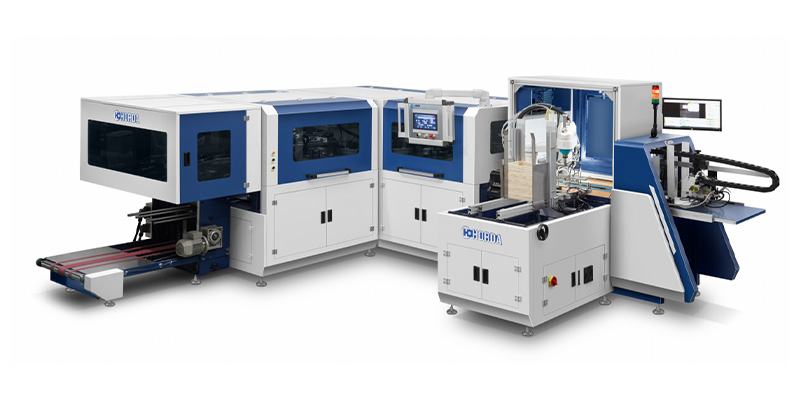
Sustainable material requirements vary by end market and geography. To understand how different industries approach sustainable packaging specifications, explore the rigid box making machine for cosmetics, wine, and electronics packaging.
For packaging manufacturers evaluating sustainable material options, a structured approach reduces risk and improves outcomes.
Determine which markets your production serves. If exporting to the EU, PPWR compliance must be planned, with the 2030 recyclability requirements approaching. For specific brand clients, request their sustainable packaging scorecard to understand recycled content targets, certification requirements, and prohibited substances.
| Sustainability Priority | Recommended Board Approach |
|---|---|
| Maximize recycled content | High recycled-content board (70–100%) |
| Premium feel + responsible sourcing | FSC-certified virgin board |
| Balance cost and sustainability | Moderate recycled content (30–50%) |
| Mixed approach | Recycled board for internal; certified board for visible panels |
Test candidate cover stocks on actual production equipment before material commitment. Pay particular attention to stretch percentage for corner folding, surface energy for adhesive bonding, and recycled content effect on surface consistency.
For any material combination, conduct small-batch testing (50–100 boxes), including accelerated aging, to verify bond integrity and coating durability.
Requirements: PPWR compliance, minimum 50% recycled content claim, no plastic coatings, water-based adhesives only.
Recommended material package: 2.0mm recycled paperboard (60% post-consumer content) with FSC-certified 120 gsm uncoated cover stock. Water-based PVA adhesive. No barrier coating—natural finish aligned with brand aesthetic.
Key consideration: Test uncoated cover stock for adhesive strike-through. Reduce adhesive application weight compared to coated stocks.
Requirements: Structural strength for bottle weight, FSC certification for responsible sourcing, high-end finish requiring coating protection.
Recommended material package: 2.5mm FSC-certified virgin fiber board (structural integrity for heavy product). FSC-certified 150 gsm coated cover stock with water-based, recyclable coating. Water-based adhesive formulated for coated surfaces.
Key consideration: Verify coating recyclability with the supplier. Request documentation confirming compatibility with paper recycling streams.
Once you have identified the sustainable material combination that meets your regulatory and customer requirements, verifying that your production equipment can consistently process these materials becomes the logical next step. Recycled board may have different feeding characteristics than virgin board. Cover stocks with alternative fibers may require adjusted folding parameters. Bio-based coatings may need modified drying protocols. Comparing specific equipment capabilities for handling sustainable materials—precision feeding, adjustable folding pressure, coating application systems—informs both material selection and potential equipment investment decisions.
To continue building your sustainable packaging production knowledge, the following topics complement this guide:
Common Quality Defects in Rigid Box Manufacturing and Their Root Causes
Material Selection Guide for Rigid Gift Boxes: Board Grades, Cover Stocks, and Adhesives
Single vs Dual Station Case Maker for Output
PPWR Compliance Checklist for Packaging Manufacturers
Validating Recycled Content Claims: Documentation and Testing Methods

 English
 Español
 Português