Your quality control team pulls a finished batch of rigid gift boxes from the production line. The lids sit unevenly on their bases—some corners lift, others dip. Stacking reveals gaps between boxes. A premium wine client’s automated filling line rejects every tenth box because lids do not close properly. Your production manager asks: “Where is this coming from, and how do we stop it?”
Warping ranks among the most persistent—and frustrating—quality defects in rigid box manufacturing. Beyond cosmetic concerns, warped boxes compromise stacking stability, reduce protective performance, and cause feeding failures in automated filling lines. For packaging manufacturers serving luxury cosmetics, wine, or electronics brands, warping can trigger costly rework, client concessions, or shipment rejection.
This guide explains the science of moisture-induced warping, provides a structured approach to identifying root causes, and outlines actionable prevention strategies across material storage, adhesive application, and production environment management.
Paperboard warps because its fundamental building block—the cellulose fiber—is naturally hygroscopic, meaning it absorbs and releases moisture in response to ambient humidity.
Cellulose fibers have a tubular structure. When exposed to moisture, the fiber walls absorb water and swell—increasing fiber diameter considerably. Conversely, when the surrounding air is dry, fibers release moisture and shrink. This expansion and contraction directly alter the board’s dimensions. A high blank moisture content leads to a loss of dimensional stability and load-bearing capacity; while a low blank moisture content increases the prevalence of ruptures during forming, but the resulting trays are stiffer and their dimensional accuracy is better.
For the cellulose fibres themselves, the relative dimensional change is larger by up to three times in the cross-fibre direction than in the length direction, meaning that expansion is not uniform across the sheet.
This asymmetry is critical. If the front and back of the paperboard sheet experience an equal amount of dimensional change, the sheet only expands or shrinks in overall size. However, when the dimensional changes are unequal (asymmetric), any given change in moisture will cause the sheet to curl.
Translating science to the production floor: Uneven moisture exposure—between the top and bottom surfaces of the board, or between the board and cover stock—creates internal stresses that manifest as warping. Controlling moisture balance is therefore not a matter of “keeping paper dry,” but of maintaining consistent moisture conditions across all surfaces and production stages.
What is the “correct” moisture condition for rigid box production? Industry standards provide a clear benchmark.
Paperboard is manufactured to be flat in a defined environment of 50% relative humidity at 20–23°C. This is the condition under which the board’s dimensional stability is optimized. According to TAPPI T 502 cm-21 (Equilibrium Relative Humidity of Paper and Paperboard), paper that is dimensionally stable at a particular relative humidity and temperature will remain unchanged as long as this condition is maintained.
For production areas, a relative humidity of 45–60% at a temperature of about 20°C is recommended to prevent curl and/or misregister.
Practical storage and processing recommendations across industry sources converge on these parameters:
| Environmental Parameter | Recommended Range | Rationale |
|---|---|---|
| Production area RH | 45–60% at ~20°C | Prevents curl; maintains dimensional stability |
| Storage warehouse RH | 45–55% | Prevents moisture uptake or loss before processing |
| Storage temperature | 18–24°C (65–75°F) | Minimizes moisture absorption and fiber tension variation |
| Board equilibrium moisture | ~6–8% (matching 50% RH) | Board manufactured to be flat at this condition |
Low humidity (<30%) causes paper to shrink, curl inward, or crack at fold lines; high humidity (>60%) creates the risk of edge wave, sheet sticking, or delamination in coated boards. Temperature and RH must be controlled together—high RH at low temperatures can cause micro-condensation, especially in barrier-coated substrates.
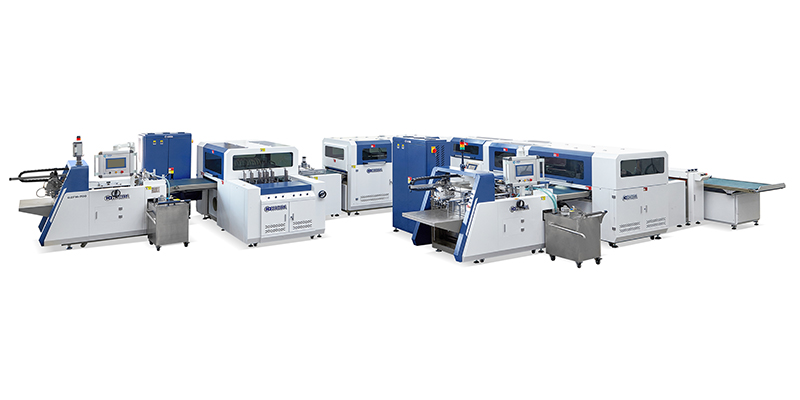
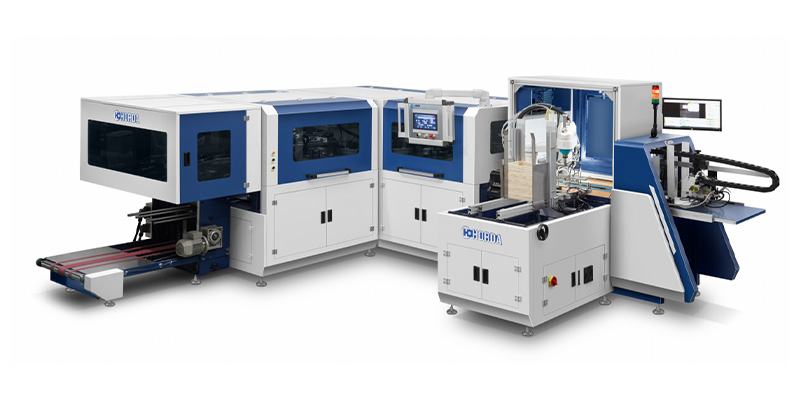
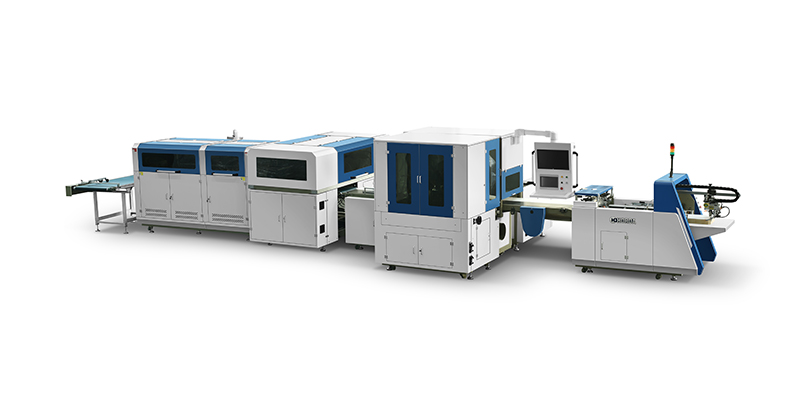
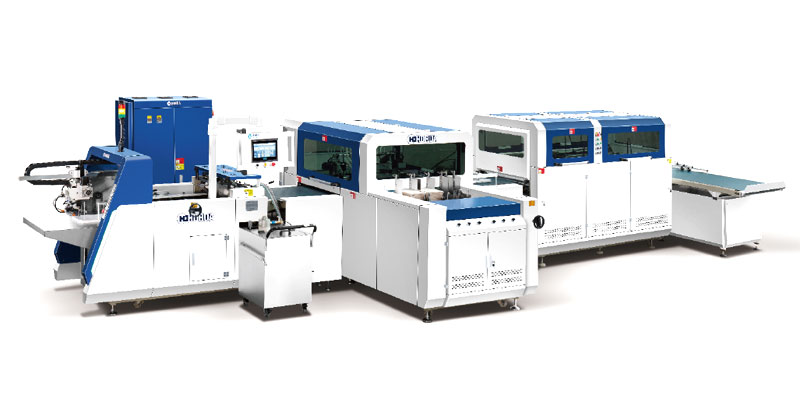
Maintaining these environmental conditions requires consistent equipment operation across shifts. For an overview of how rigid box production systems handle material variability under controlled conditions, explore the rigid box making machine line specifications, including feeding and adjustment features.
Warping can originate at multiple points in the production chain. A systematic diagnostic process helps isolate the cause before implementing solutions.
Different warp patterns point to different root causes.
| Warp Pattern | Typical Direction | Likely Root Cause |
|---|---|---|
| Up warp | Board bows upward (convex) | The top surface dries faster than the bottom |
| Down warp | Board bows downward (concave) | Bottom surface dries faster than the top surface |
| Edge warp | Curl along sheet edges | Uneven moisture exposure or temperature across the sheet width |
| S warp | Bows up on one corner, down on opposite | Asymmetric moisture across diagonal |
| Twist warp | Curve along diagonal | Combined moisture and tension issues |
Before assuming the problem is on your production floor, verify the board’s condition upon receipt.
Measure board flatness on a flat surface immediately after unpacking.
Test moisture content using oven-drying method (ASTM D644) or pin-type moisture meter.
Verify original packaging (moisture-proof wrapper) was intact. The wrapper ensures protection against moisture changes, but only as long as it is undamaged.
Check storage conditions before board is moved to production.
Case board warp often traces to the board’s exposure history before it reaches the production floor. When the board arrives at the facility, it could be stored in an unheated warehouse or a tropical climate—both scenarios widely differ from the moisture content the paperboard requires.
Adhesive is a direct source of moisture introduced during production.
The amount of glue applied to the board will affect the likelihood of warping. If you add more glue, you add more moisture, which can accelerate distortion because the porous board will absorb the water. Using a mil depth gauge is the best way to ensure you are applying the correct amount of adhesive.
Excessive adhesive application—not too little—often causes warping. Applying extra glue to a substrate does not mean the bond will be stronger, and the additional moisture can cause the board to warp.
Install temperature and RH sensors in:
Board storage area (before cutting)
Production floor near the case maker
Finished box staging area
A temperature difference of 1°C can be almost as effective as a 2% RH change in affecting the physical properties of paper and board.
Run a controlled experiment: process a batch of boards while logging temperature and RH at each station. Compare warping incidence across boards processed on days with different ambient conditions. If warping worsens on high-humidity days or low-humidity winter days, environmental control is likely the primary variable.
Many customers have issues with board warp in the winter months when there is very low humidity outside, making the environment very dry.
Once root causes are identified, implement targeted controls.
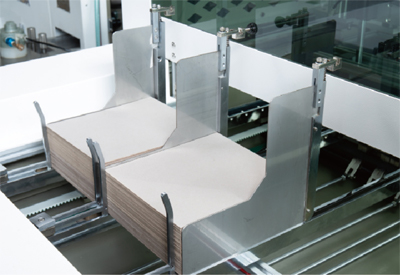
Action 1: Leave packaging intact until use. Leave the moisture-proof wrapping on the pallet or reel up to the point where the paperboard is to be converted. The wrapper ensures protection against moisture changes, but only as long as it is undamaged. Do not leave the paperboard pallets outdoors, not even under a roof.
Action 2: Store on raised pallets, not on concrete floors. Bare concrete can wick moisture upward into stored board. Use raised pallets, slip sheets, or steel racking to protect from contamination and physical deformation.
Action 3: Allow acclimatization. Let paperboard sit in the production area 24–48 hours before converting to stabilize to room conditions. When cold paperboard is exposed to a warm environment, the air adjacent to the board can be cooled below its dew point, and moisture is then absorbed by the board.
Action 4: Implement FIFO inventory rotation. Pallet loads that age for extended periods become brittle and may experience gradual moisture migration before use.
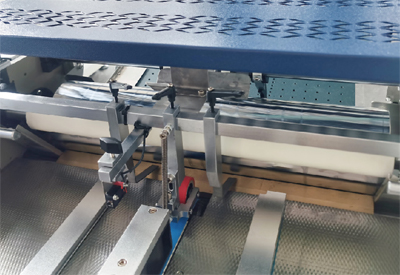
Action 1: Apply the minimum effective glue quantity. The amount of glue applied to the board will affect the likelihood of warping. If you add more glue, you add more moisture. You want to use the least amount of glue possible to achieve your desired adhesion.
Action 2: Use a mil depth gauge. A mil depth gauge is the best way to ensure you are applying the correct amount of adhesive. For gelatin glues, applying 1 to 2 mils of adhesive to substrates is typical.
Action 3: Maintain consistent adhesive viscosity. Automated viscosity control systems prevent drift in adhesive solids content, which changes the amount of water delivered to the board per unit area.
Action 4: Consider adhesive type. Water-based cold glues introduce more moisture to the board than hot melt adhesives, which set primarily by cooling rather than water evaporation. For board stock highly sensitive to moisture, hot melt formulations may reduce warping risk.
Action 1: Install dedicated humidity control. Direct in-room humidification systems can control relative humidity precisely inside the production area. If the room humidity falls below the optimum, the material releases moisture and the cardboard shrinks, causing curling.
Action 2: Shield the board from direct airflow. Position board storage and production staging away from HVAC vents, open loading bay doors, and direct sunlight exposure. Temperature fluctuations near loading bays can create condensation or heat pockets.
Action 3: Monitor with data loggers. Use temperature and RH sensors in storage areas, production zones, and—if possible—in transit. Environmental tracking provides early warning before widespread warping occurs.
Action 1: Allow staged drying before stacking. Boxes fresh from production contain residual moisture from adhesive. Stacking immediately traps this moisture, creating uneven drying conditions. Open rack drying for 4–6 hours allows moisture equalization.
Action 2: Rewrap printed/processed board. The printing process can cause a reduction in the paperboard’s moisture content, especially when the sheet has been IR or UV dried. Rewrapping with moisture-proof material after printing is important to maintain register and flatness.
Action 3: Use cross-stacked pallets with tier sheets. Even pressure distribution during storage and transit reduces warping from mechanical compression forces.
Warping is one of several moisture-related quality issues. To understand how moisture interacts with other defect types, such as delamination and corner wrinkling, explore the rigid box making machine for cosmetics, wine, and electronics packaging.
Situation: A rigid box manufacturer in a temperate climate receives warping complaints only between November and February. The production environment is not climate-controlled.
Diagnosis: Low outdoor humidity (often below 30% RH in winter) causes rapid moisture loss from board surfaces during processing. The side exposed to warm production air loses moisture faster than the bottom side or interior of stacks.
Solution package: Install direct in-room humidification in the board storage and production areas to maintain 45–50% RH. Add a 24-hour board acclimatization before processing. Reduce adhesive application weight during winter months. Result: warping incidence drops from 8% to under 1.5%.
Situation: A high-volume contract packaging manufacturer processes boards within 48 hours of receipt. Warping rates vary unpredictably between pallets of the same board grade from the same supplier.
Diagnosis: Some pallets show wrapper damage from forklift handling. Damaged wrappers allowed moisture absorption during storage. Board moisture content measured using oven-drying method (ASTM D644) confirms that warped batches have moisture content 2–3 percentage points above target.
Solution package: Implement incoming inspection for wrapper integrity before accepting pallets into storage. Train forklift operators on careful handling of wrapped pallets. Establish moisture content testing protocol for incoming board.
Controlled humidity delivers measurable benefits beyond warping prevention:
Reduced waste: Elimination of moisture-related warping typically reduces total scrap rates by 30–50% for affected product lines.
Improved automated filling compatibility: Flat boxes feed reliably through automated filling lines, eliminating rejections and line stoppages.
Consistent stacking stability: Flat boxes stack evenly, reducing damage to lower boxes in pallet loads and improving shipping density.
Lower client rejections: Cosmetic, wine, and electronics brands increasingly incorporate flatness specifications into packaging quality agreements.
Once you have implemented moisture control measures across material storage, adhesive application, and production environment, verifying that your equipment can consistently process moisture-stable materials becomes the logical next step. Board stiffness, cover stock behavior, and adhesive performance all interact with environmental conditions. Comparing specific equipment capabilities for handling moisture-controlled materials—precision feeding, adjustable folding pressure, adhesive application systems—informs both process improvement and potential equipment investment decisions.
To continue building your rigid box production expertise, the following topics complement this guide:
Common Quality Defects in Rigid Box Manufacturing and Their Root Causes
Material Selection Guide for Rigid Gift Boxes: Board Grades, Cover Stocks, and Adhesives
Single vs Dual Station Case Maker for Output
Adhesive Selection for Warping Prevention
Warehouse Environmental Control for Paperboard Storage

 English
 Español
 Português