A premium cosmetics brand approaches you with a new product line. A wine distributor needs 50,000 rigid gift boxes for next season’s vintage. A smartphone manufacturer requires consistent, high-quality packaging for their latest release. Each opportunity represents growth—and each requires the production capacity to deliver.
For packaging manufacturers serving luxury cosmetics, wine, tobacco, mobile phone, and gift box markets, the hardcover production line is the backbone of their operation. Investing in the right equipment is not simply a capital expenditure—it is a strategic decision that will affect your production capacity, quality consistency, labor costs, and competitive positioning for years to come.
This 2026 buying guide provides a practical framework for evaluating hardcover production lines. We examine the key factors to consider before making a purchase, compare different production line types, and outline the questions you should ask potential suppliers.
Before comparing equipment specifications, you must understand your own production environment. The right machine for a high-volume, low-mix operation is rarely the right machine for a low-volume, high-mix custom shop.
Three questions to answer with your team:
1. What is your current and projected production volume? If you are producing 5,000–10,000 rigid boxes daily, your equipment needs differ significantly from a manufacturer producing 20,000+ boxes per day. According to industry data, the global rigid box market was valued at $68.34 billion in 2026 and is projected to reach $100.35 billion by 2034, growing at a 4.92% CAGR. The luxury rigid box segment alone is valued at approximately $8.84 billion in 2026. This growth suggests that manufacturers who invest in scalable equipment now will be better positioned to capture expanding market demand.
2. What is your product mix? Do you produce the same box size and style for months, or do you switch between 10+ different SKUs weekly? The frequency of changeovers directly affects which features you should prioritize.
3. What are your quality requirements? Luxury cosmetic and wine boxes demand precision alignment and flawless finishes. Industrial packaging may have more forgiving tolerances. Your quality standards determine the level of precision and control you need from your equipment.
Once you document your volume range, typical order sizes, and quality requirements, you establish a baseline against which every equipment option can be measured.
For manufacturers undertaking varied production batches, it is critical to understand how different machine series improve product changeover efficiency. You may examine the core design concepts adopted on modern rigid box making machines and learn how modular setups enable flexible mixed production.
One of the first decisions you will face is whether to invest in a rigid box line or a collapsible box line. These two approaches serve different production needs and market positions.
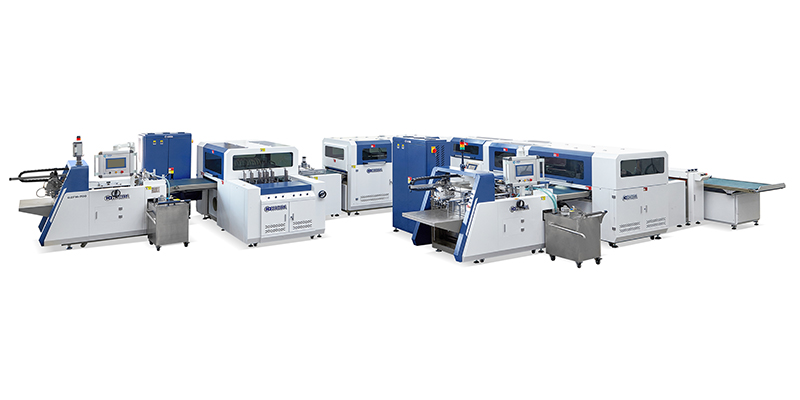
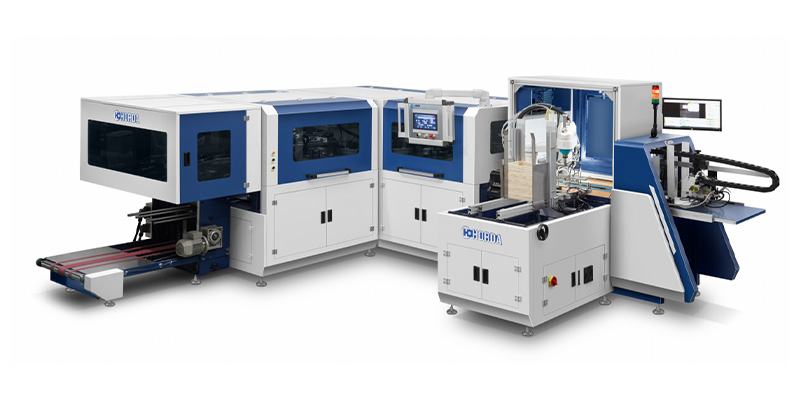
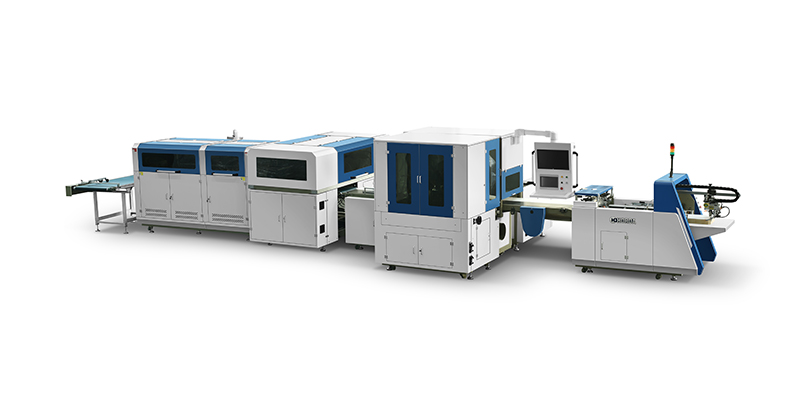
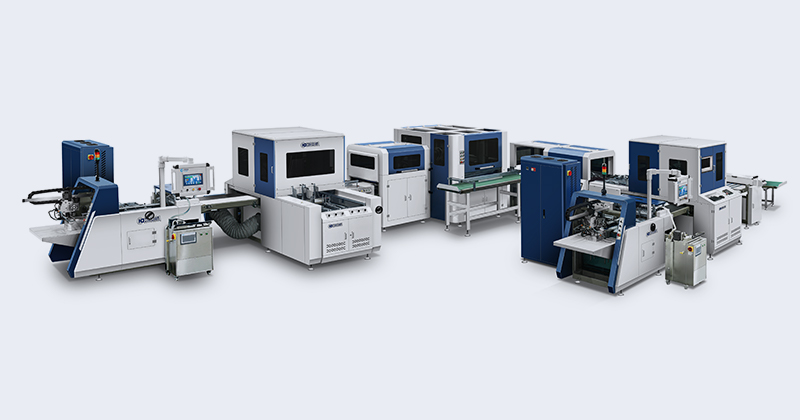
Rigid box lines produce pre-assembled, non-collapsible boxes built from thick chipboard wrapped in decorative paper, fabric, or leatherette. The boxes are delivered fully assembled and do not collapse. HORDA’s rigid box making machine, for example, produces book-shaped hardcover boxes used for cosmetic boxes, tobacco and alcohol boxes, and mobile phone boxes. The machine integrates multiple functional modules to achieve full-process automation from production and processing to assembly.
What this means for your production floor: A rigid box line produces boxes that are immediately ready for filling and display. No assembly is required at the point of use. However, rigid boxes occupy their full three-dimensional volume throughout storage and shipping.
Collapsible box lines manufacture boxes that can be folded flat for storage and shipping, then assembled into their final form at the point of use. HORDA’s collapsible box making machine processes materials such as cardboard into the shape of folding box wings, used to produce gift boxes, sweet boxes, and cosmetic boxes. The machine features 12 servo systems that accurately complete each process.
Key difference: Collapsible boxes can reduce shipping volume by 50–80% compared to assembled rigid packaging. However, the assembly step—whether manual or automated—must occur somewhere in the supply chain.
| Factor | Rigid Box Line | Collapsible Box Line |
|---|---|---|
| Box structure | Pre-assembled, non-collapsible | Ships flat; assembled at point of use |
| Storage efficiency | Full volume at all times | Reduced storage footprint by 50–80% |
| Shipping cost | Higher freight expenses | Lower freight costs |
| Production speed | 25–40 pieces per minute | Automated; 12 servo systems |
| Typical applications | Luxury cosmetics, wine, tobacco, mobile phones | Gift boxes, sweet boxes, cosmetic boxes |
Selection guidance: Choose a rigid box line if your clients expect premium, ready-to-use packaging and storage costs are not the primary constraint. Choose a collapsible box line if logistics efficiency and space savings are critical to your operation.
Machine speed is one of the first specifications buyers consider—and one of the most misunderstood. HORDA’s rigid box making machine can produce 25–40 pieces per minute. However, sustained throughput over a full shift, including changeovers and minor stops, typically runs below nameplate speed.
What this means for your floor: A machine rated at 40 pieces per minute loses its advantage if changing from one box size to another requires extensive adjustment time. The adjustment time for regular products on HORDA’s machines is approximately 20 minutes. For manufacturers with frequent changeovers, this quick adjustment capability may be more valuable than peak speed.
Your equipment must accommodate the dimensions of your products. HORDA’s rigid box production line accommodates material sizes ranging from a minimum of 60mm × 120mm up to a maximum of 750mm × 1350mm. This size range covers most rigid box applications, from small mobile phone boxes to large wine gift boxes.
What this means for your floor: Verify that the equipment you are considering can handle your full range of box sizes—not just your current sizes, but the sizes you may need in the future as your business grows.
For luxury packaging, even a 0.5mm misalignment creates visible defects. HORDA’s equipment ensures precise positioning to eliminate product deviations. Advanced models such as the ZTC-700B Automatic Case Lining Machine (CCD) adopt new technologies including high-precision camera precise positioning and robot fast board feeding.
What this means for your floor: Consistent accuracy reduces scrap rates and rework labor. When evaluating equipment, distinguish between “maximum achievable accuracy” (measured in ideal conditions) and “sustained accuracy during production” (what matters to your quality control team).
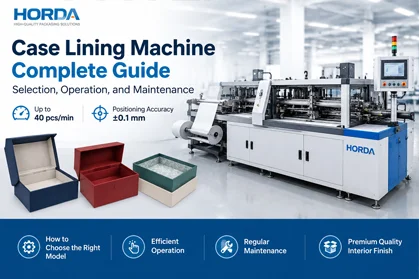
Modern hardcover production lines feature sophisticated automation. HORDA’s case lining machine adopts a motion control system with fast response speed and stable performance, reaching a maximum production speed of 40 pieces/minute. Features include visual positioning technology, intelligent control systems that reduce energy consumption, and removable glue tanks for easy cleaning.
What this means for your floor: Automation reduces labor costs and operator error. However, the level of automation should match your production volume and operator skill levels. Over-automation for a small operation may not deliver return on investment.
Adhesive application is a common source of quality issues. HORDA offers an optional intelligent glue tank with automatic water addition and automatic adjustment of glue concentration. Viscosity control systems are available as optional equipment—not standard—on case making machines.
What this means for your floor: Consistent glue viscosity prevents warping, delamination, and edge lifting. For high-volume operations or multi-shift production, automated viscosity control is often worth the investment.
All HORDA machines have CE, ISO9001-2008, and IEC certificates, complying with international quality and export standards. The company has more than 40 invention patents and utility model patents, with an annual R&D investment of over USD 1 million.
What this means for your floor: Certifications indicate compliance with safety and quality standards. A company’s patent portfolio and R&D investment suggest ongoing innovation and commitment to product improvement.
Understanding the unique packaging production demands across different industries can greatly help you finalize your machine purchase decisions. Browse our hardcover box making machines for cosmetic boxes, wine gift boxes, and electronic product gift boxes.

When evaluating potential equipment suppliers, ask these questions to assess their capability and reliability:
1. How long have you been manufacturing this type of equipment? HORDA was founded in 2007, with over 18 years of R&D and manufacturing experience. Longevity suggests stability and accumulated expertise.
2. What is your production capacity and lead time? Understand how quickly the supplier can deliver and install your equipment.
3. What training and support do you provide? HORDA provides training manuals, debugging videos, and round-the-clock online video guidance to assist until problems are resolved. Clarify what support is included and what costs extra.
4. Can you provide references from similar operations? Ask for contact information of customers with similar production profiles. Their experience will tell you more than any brochure.
5. What spare parts do you stock, and what is your response time for service? Downtime costs money. Ensure the supplier can support your operation post-installation.
6. What optional features should I consider? HORDA offers optional features including intelligent glue tanks with viscosity control and CCD vision systems. Understand which options are essential for your operation and which are nice-to-have.
| Mistake | Why It Happens | Better Approach |
|---|---|---|
| Focusing only on maximum speed | Brochures highlight peak output | Request average sustained speed over a full shift, including changeovers |
| Choosing maximum flexibility without need | Fear of future requirements leads to over-specification | Project realistic product mix for the next 3 years, not 10 years |
| Underestimating operator skill requirements | Assumption that “fully automatic” means minimal training | Ask about training materials and typical ramp-up time for new operators |
| Ignoring total cost of ownership | Focus on initial purchase price rather than lifecycle costs | Compare energy consumption, maintenance costs, and labor requirements |
| Not visiting the factory or seeing a live demonstration | Relying on online information alone | Request a factory visit or video demonstration of the machine running your materials |
Profile: A packaging manufacturer produces 10,000–15,000 rigid boxes daily for mid-range cosmetic brands. Product mix includes 5–8 different box sizes weekly. Currently using manual and semi-automatic equipment. Quality issues and labor costs are growing concerns.
Recommended approach: A semi-automatic to fully automatic rigid box line with quick changeover capability. The 20-minute adjustment time for regular products enables efficient production across multiple SKUs. Optional CCD vision positioning ensures consistent quality for cosmetic packaging. Production speed of 25–40 pieces per minute supports volume requirements.
Key consideration: Prioritize equipment with intuitive controls and comprehensive training support to minimize operator ramp-up time.
Profile: A contract manufacturer produces 25,000+ rigid boxes daily for a smartphone brand. Production runs are standardized with minimal variation. Quality consistency and speed are the top priorities.
Recommended approach: A high-speed, fully automatic rigid box line. The integrated multiple functional modules achieve full-process automation from production and processing to assembly. The machine processes diverse paper materials with flexible production switching.
Key consideration: Evaluate optional features such as intelligent glue tanks with automatic viscosity control to maintain consistent quality across long production runs.
Once you have clarified your production volume, product mix, quality requirements, and budget, comparing specific equipment specifications becomes the logical next step. Not all hardcover production lines offer the same changeover speed, precision, or automation features. Technical specifications for feeding systems, glue application, positioning accuracy, and control interfaces differentiate equipment that appears similar on paper. Reviewing these specifications in light of your specific production needs will help you make an informed investment decision.
To continue building your hardcover production line knowledge, the following topics complement this guide:
How Adhesive Viscosity Affects Case Lining Quality and Consistency
Material Selection Guide for Rigid Gift Boxes: Board Grades, Cover Stocks, and Adhesives

 English
 Español
 Português