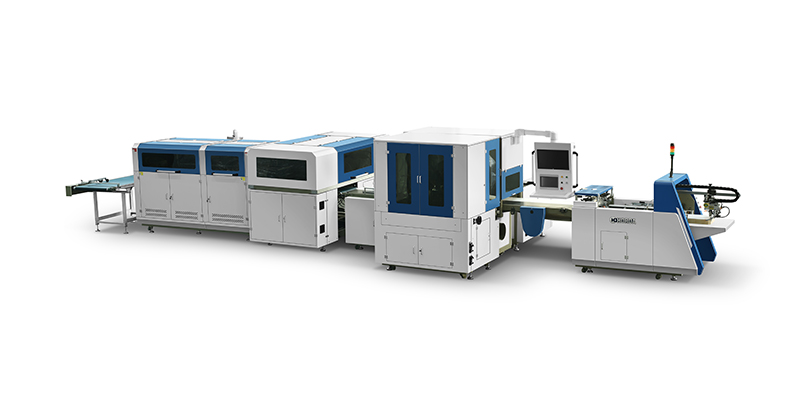
You have identified the need for a hardcover production line. The budget is approved. Now you face a wall of technical specifications from multiple suppliers—speed ratings, accuracy claims, size ranges, power requirements, and a dozen other numbers that seem designed to confuse rather than clarify.
Choosing between equipment options requires more than comparing maximum speed figures. The specification sheet that looks impressive on paper may translate poorly to your production floor. Understanding what each specification actually means—and how it affects your operation—is essential for making a sound investment decision.
This guide breaks down the key technical specifications for hardcover production equipment, explains what each specification means for your production, and provides a framework for comparing options based on your specific requirements.
Maximum production speed is typically the first specification buyers compare—and one of the most frequently misunderstood.
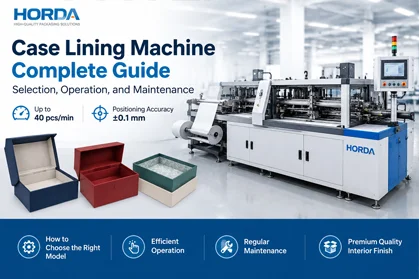
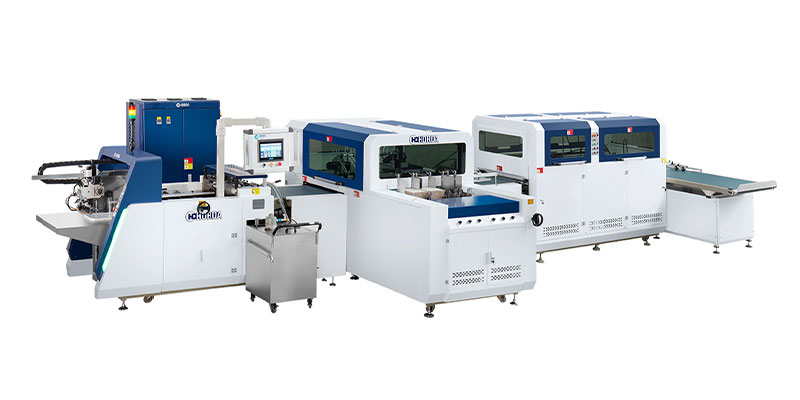
For hardcover equipment, speed is measured in pieces per minute. Entry-level machines typically run at 25–30 cycles per minute, while high-speed lines can reach 40–60 cycles per minute. HORDA’s ZFM-700B, for example, achieves a maximum speed of 40 pieces per minute.
What this means for your production: A machine rated at 40 pieces per minute will rarely sustain that speed across an entire shift. Sustained throughput typically runs 15–25% below nameplate speed due to changeovers, material feeding, and minor stops. For manufacturers with frequent product changes, a machine with slightly lower top speed but faster changeover capability may deliver higher overall output.
Key questions to ask:
What is the average sustained speed over a full shift, including changeovers?
How long does a typical size changeover take?
Does the machine store recipes for quick recall of previous jobs?
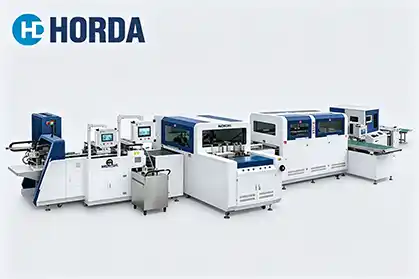
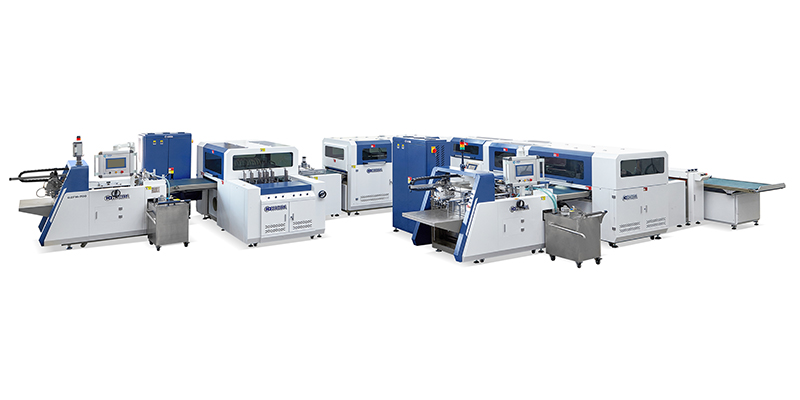
For a detailed look at how HORDA’s hardcover equipment integrates speed with automation features, explore the rigid box production line specifications including speed and adjustment capabilities.
Positioning accuracy determines how precisely the cover material aligns with the board. For luxury packaging, even a 0.5mm misalignment creates visible defects that can result in rejected product.
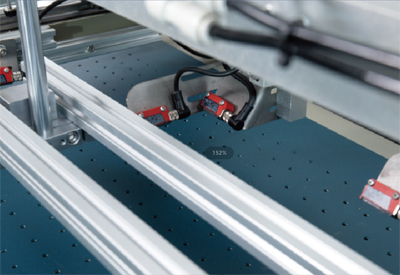
In hardcover equipment, accuracy is typically measured in millimeters (±mm). Standard machines may offer accuracy within ±0.2mm to ±0.5mm. Advanced CCD vision systems achieve accuracy within ±0.1mm. HORDA’s ZFM-700B features positioning accuracy of ≤0.1mm, using high-precision cameras and robotic board feeding to maintain this precision.
What this means for your production: Higher accuracy reduces scrap rates and rework. For premium cosmetic, wine, and electronics packaging where alignment is critical, accuracy of ≤0.1mm may be essential. For less demanding applications, ±0.2mm–±0.5mm accuracy may be sufficient and more cost-effective.
Key questions to ask:
What is the positioning accuracy under sustained production conditions (not just ideal laboratory settings)?
What technology is used to maintain accuracy (mechanical stops, servo motors, or vision systems)?
How does accuracy vary with different material types?
Size range defines the minimum and maximum product dimensions the machine can process. This specification directly determines whether the equipment can handle your current and future product requirements.
For hardcover equipment, key size parameters typically include:
Maximum and minimum finished product size: Often expressed as length × width. For example, the ZFM-700B handles sizes from 90mm × 180mm up to 450mm × 720mm. The Diamant MC 30 handles book block sizes from 100mm × 100mm up to 305mm × 380mm.
Board thickness range: Typically 1–4mm, with optional devices for thinner boards.
Spine width: Particularly relevant for book production, ranging from 6–80mm.
Paper thickness/grammage: Often expressed in grams per square meter (gsm), typically 80–300 gsm.
What this means for your production: Ensure the equipment can handle your full range of product sizes—not just your current sizes, but the sizes you may need in the future. Equipment that cannot accommodate larger or smaller products will limit your business growth.
Key questions to ask:
What is the machine’s maximum and minimum product size?
Does the size range include the dimensions of your current and planned products?
How easy is it to adjust between sizes within the machine’s range?
Evaluating size specifications for various end‑products across industries supports better equipment selection. Review practical application scenarios of hardcover case making machines on our Hardcover Books File Folder page.
Automation level determines how much operator intervention is required and how consistently the machine produces quality output.
Key automation features to evaluate include:
| Feature | What It Does | Benefit |
|---|---|---|
| Motion control system | Coordinates machine movements with high precision | Faster response, stable performance |
| CCD vision positioning | Uses cameras for precise alignment of materials | Accuracy within ±0.1mm; reduces manual adjustment |
| Servo drives | Electrically controlled motors for precise movement | More accurate than pneumatic systems; energy efficient |
| PLC/ touch-screen control | Centralized control with visual interface | Easier operation; stores recipes for repeat orders |
| IoT connectivity | Remote monitoring and troubleshooting | Reduces downtime; enables predictive maintenance |
Motion control systems have become standard in modern hardcover equipment. The Diamant MC 30, for example, features servo-driven single drives at the rounding station, in the transport chains, and in the casing-in station, ensuring precise movements and flexibility that result in less downtime and more output.
PLC and touch-screen controls allow operators to enter production data, store settings for repeat orders, and diagnose issues quickly. The Diamant MC 30 features a central area for entering data with a measuring device and clear visualization, with the ability to prepare the next order during ongoing production.
IoT connectivity enables remote troubleshooting, capacity monitoring, and system upgrades—features that can significantly reduce downtime and service costs.
What this means for your production: Higher automation reduces labor costs and operator error. However, the level of automation should match your production volume and operator skill levels. Over-automation for a small operation may not deliver return on investment.
The glue system is critical for consistent lamination quality. Key specifications and options include:
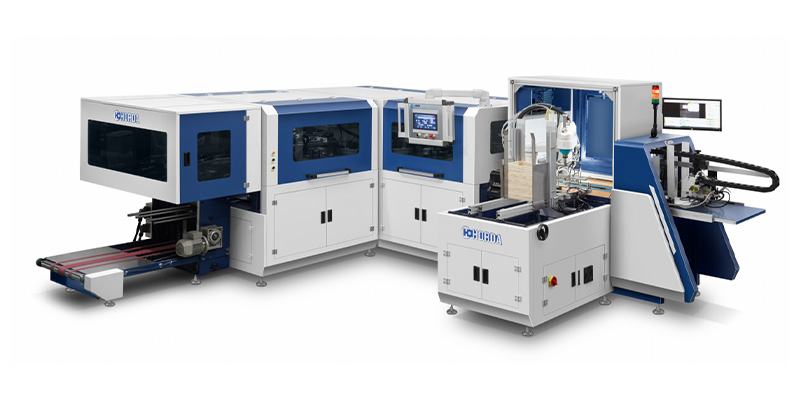
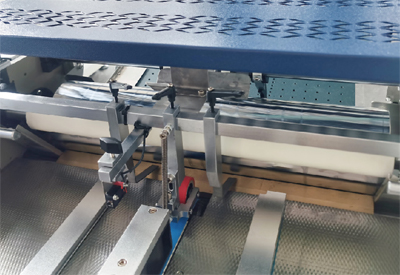
Glue tank design: Removable stainless steel glue tanks facilitate easy cleaning and maintenance. HORDA’s ZFM-700B features a removable stainless steel glue tank with a thermal insulation layer that reduces energy consumption by up to 60% compared to similar products.
Viscosity control: Automated viscosity control systems continuously monitor glue viscosity and add water automatically to maintain consistency. This is listed as an optional feature, not standard equipment, on many hardcover case making machines.
Cold glue vs hot melt: Some machines support both adhesive types. HORDA’s optional cold glue system includes a glue pump specifically for cold glue use, satisfying requirements for making various products.
Heating systems: For hot melt adhesives, temperature-controlled glue tanks and heating elements are essential. Some systems feature automatic constant temperature heating to prevent roller sticking caused by water vapor.
What this means for your production: A well-designed glue system prevents warping, delamination, and edge lifting. For high-volume operations or multi-shift production, automated viscosity control is often worth the investment.
Power consumption affects both operating costs and environmental footprint. Total power requirements for hardcover equipment typically range from 8kW to over 50kW depending on machine size and features.
What this means for your production: Energy costs add up over the life of the equipment. A machine with 30% lower power consumption—as HORDA claims for its equipment—can save thousands of dollars annually in electricity costs. Energy efficiency should be considered alongside initial purchase price when calculating total cost of ownership.
Component quality affects reliability, maintenance costs, and machine lifespan. Key components to evaluate include:
| Component | What to Look For | Why It Matters |
|---|---|---|
| Servo motors | Panasonic, ESTUN, or similar reputable brands | Reliable, precise, and long-lasting |
| Linear guides | Taiwan PMI or equivalent | Accurate movement; low wear |
| Pneumatic components | CKD, SMC, or AIRTAC | Reliable operation; easy parts replacement |
| Sensors | Leuze, Keyence, or equivalent | Consistent detection; low failure rate |
| Bearings | NSK, SKF, or equivalent | Long service life; low maintenance |
Certifications indicate compliance with international quality and safety standards. Look for:
ISO 9001: Quality management system certification
CE: European safety standard compliance
IEC: International Electrotechnical Commission standards
What this means for your production: Machines built with high-quality components from reputable suppliers typically have longer service life, lower maintenance costs, and higher reliability. Cheaper components may save money initially but cost more in downtime and repairs over time.
Build quality and precision directly affect defect rates. For a detailed analysis of how equipment specifications relate to quality outcomes, refer to our comprehensive guide on quality defect diagnosis in rigid box manufacturing.
| Specification | What to Compare | Questions to Ask |
|---|---|---|
| Speed | Max speed vs. sustained speed | What is average speed including changeovers? |
| Accuracy | Positioning accuracy (±mm) | How is accuracy maintained during production? |
| Size range | Min/max product dimensions | Can it handle your future product sizes? |
| Automation | Control system; vision; servo | What is the learning curve for operators? |
| Glue system | Tank type; viscosity control | Does it support your adhesive type? |
| Power | Total power consumption | What are annual energy costs? |
| Components | Brand of servos, sensors, pneumatics | How easy is it to get replacement parts? |
| Certifications | ISO, CE, IEC | Has the machine been independently tested? |
Profile: Produces 10,000–15,000 rigid boxes daily for mid-range cosmetic brands. Product mix includes 5–8 different box sizes weekly. Currently using semi-automatic equipment.
Key requirements: Sustained speed of 25–30 pieces per minute, accuracy of ±0.1mm for cosmetic packaging, size range covering 90mm × 180mm to 450mm × 720mm, CCD vision positioning for consistent quality, and quick changeover capability for mixed production.
Recommended focus: Prioritize accuracy and changeover speed. The ZFM-700B’s motion control system with CCD vision positioning (accuracy ≤0.1mm) and 20-minute adjustment time for regular products would be well-suited.
Profile: Produces 25,000+ rigid boxes daily for a smartphone brand. Production runs are standardized with minimal variation. Speed and consistency are top priorities.
Key requirements: Speed of 35–40 pieces per minute or higher, high accuracy (±0.1mm), large size range to accommodate various phone models, and reliable automation for minimal operator intervention.
Recommended focus: Prioritize maximum speed and automation. Look for machines with high-speed servo systems, automatic feeding, and IoT connectivity for remote monitoring and troubleshooting.
Once you have identified your key requirements across speed, accuracy, size range, automation, and component quality, comparing specific equipment implementations becomes the logical next step. Not all machines that claim the same speed achieve it consistently. Not all vision systems deliver the same accuracy under production conditions. Technical specifications for motion control, glue application, and positioning systems differentiate equipment that appears similar on paper. Reviewing these specifications in light of your specific production needs will help you make an informed investment decision.
Troubleshooting Common Adhesion Failures in Rigid Box Lamination
How Adhesive Viscosity Affects Case Lining Quality and Consistency

 English
 Español
 Português